


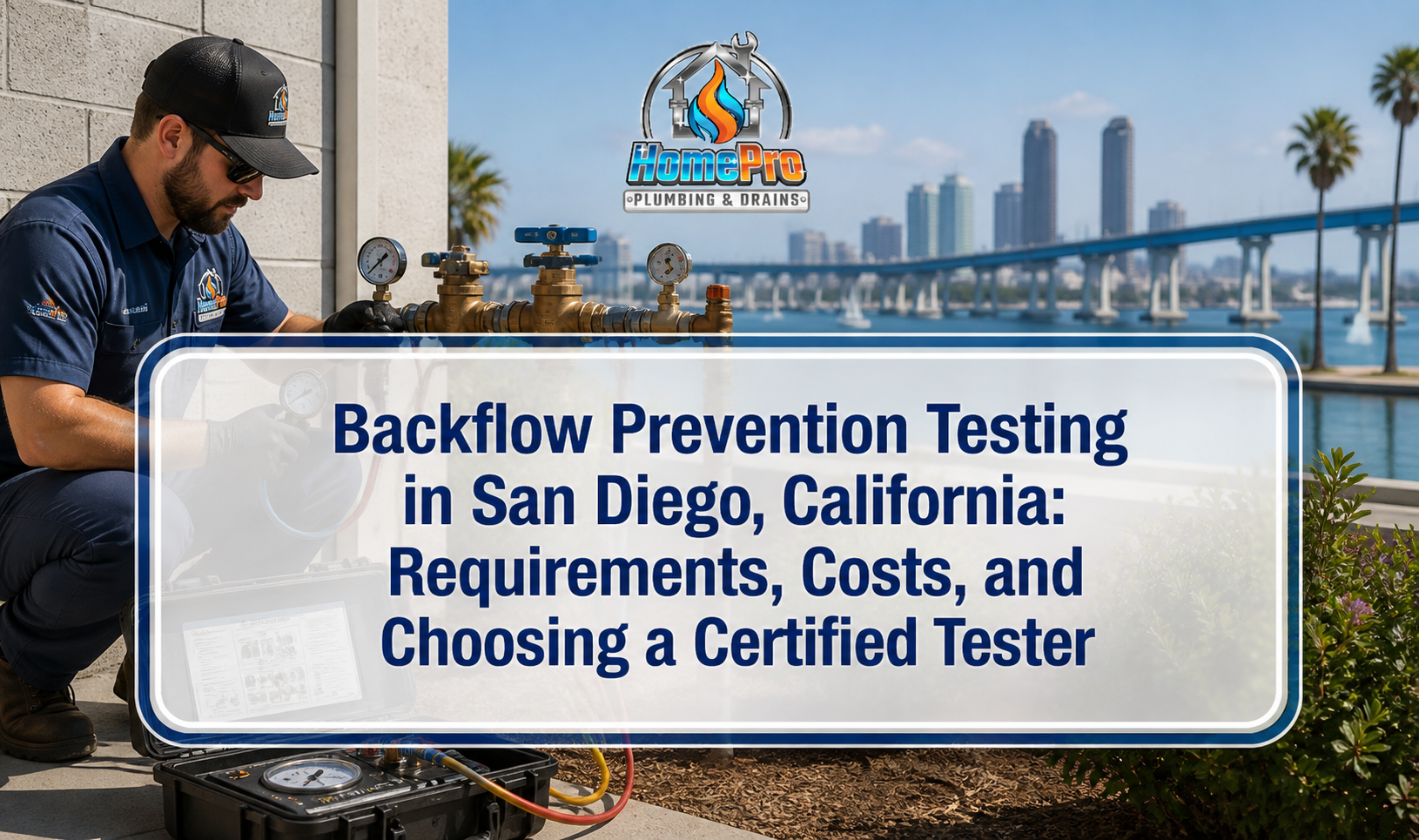
Backflow Prevention Testing in San Diego, California: Requirements, Costs, and Choosing a Certified Tester
Key Takeaways
Backflow prevention testing San Diego is generally required when your water purveyor’s cross-connection control program lists your service as having a testable backflow assembly, with frequency and due dates varying by district and hazard level. A certified tester uses calibrated differential pressure gauges to verify the assembly meets pass criteria and completes documentation that the local program will accept.
- Program-driven compliance: Testing is most commonly required on a recurring schedule (often annually) and may also be required immediately after installation or replacement, after repairs, or after incidents like main breaks or pressure issues, depending on your local agency.
- Device type determines the test focus: RP/RPZ, DC/DCVA, and some PVB/SVB devices are tested using approved field sequences to verify check performance (and relief valve operation for RPs), while other devices like many AVBs are generally verified by correct placement and condition rather than “testable assembly” reporting.
- Documentation and site conditions affect outcomes: Cost and smooth compliance depend on factors like device size/type, access, shutoff valve condition, and whether the device passes on the first visit, and a “pass” can still create problems if forms, serial/location details, or submission requirements don’t match your water purveyor’s process.
Backflow prevention testing San Diego is typically required when a property has a backflow prevention assembly installed to protect the public water supply from contamination due to backpressure or backsiphonage. In practice, testing is performed with calibrated gauges by a qualified tester, and results are documented for the local water purveyor or agency overseeing the cross-connection control program.
This matters because irrigation systems, fire lines, commercial equipment, and certain plumbing configurations can create conditions where non-potable water could flow backward into potable lines if a device fails. Routine testing confirms the assembly’s check valves and relief components operate correctly and helps reduce health risks, nuisance shutoffs, and compliance issues that can affect service.
Below, you’ll learn common local requirements that drive testing, typical cost factors in the San Diego area, and how to choose a certified tester by verifying training, test equipment calibration, and proper documentation for submittal.
When backflow prevention testing is required in San Diego
Backflow prevention testing San Diego is usually triggered by a cross-connection control program requirement from your local water purveyor, especially when a testable backflow preventer is installed on a service line.
In San Diego County, “who requires it” and “how often” can vary by water district, property type, and the degree of hazard created by the plumbing or process connected to the potable system. The most common scenario is an annual test requirement for testable assemblies (for example, a reduced pressure principle assembly or a double check valve assembly), but you should confirm the exact due date and frequency with the agency that sent the notice or maintains your account.
- New installation or replacement: Many agencies require a passing test immediately after install and before the device is accepted into the program records.
- Routine compliance testing: Often scheduled on a recurring basis (frequently yearly) to verify internal checks and relief components are functioning.
- After repairs: If a check valve, relief valve, or internal rubber parts are replaced, a re-test is commonly required to document the repair was successful.
- After an incident: Main breaks, service line work, suspected contamination events, or pressure issues may lead to additional testing.
If you’re unsure what’s installed or where it is, a qualified plumber or tester can help identify the assembly type, size, and location so you can match it to the correct testing procedure and paperwork.
What “backflow” means (and why testing focuses on pressure)
Backflow is unwanted reverse flow that can carry contaminants into drinking water lines, and it typically happens due to a pressure imbalance.
Two conditions are most commonly discussed in cross-connection control:
- Backpressure: When pressure on the customer side becomes higher than the supply pressure, pushing water backward (for example, boosted systems, boilers, certain pumps, or elevated piping).
- Backsiphonage: When supply pressure drops (such as during hydrant use, a water main break, or nearby high demand), potentially pulling water backward.
A backflow prevention assembly is designed to stop reverse flow using check valves and, for some device types, a relief valve. Testing matters because many failures are not obvious from the outside—springs weaken, check valves don’t seal perfectly, debris gets lodged, or internal seals degrade over time.
For a basic overview of how building water systems fit together, it helps to understand broader plumbing concepts like potable distribution, pressure, and cross-connections.
Common backflow device types you’ll see on San Diego properties
Most testing calls come down to identifying the assembly type and applying the correct field test method with calibrated gauges.
Backflow preventers are selected based on the degree of hazard (health vs. non-health), whether backpressure and/or backsiphonage are expected, and how the system is used. Some devices are testable assemblies; others (like many vacuum breakers) are not typically tested the same way and may be inspected instead, depending on program rules.
Reduced Pressure Principle Assembly (RP / RPZ)
RP assemblies are commonly used for higher-hazard connections because they include a relief valve that discharges if checks don’t maintain the required differential pressure.
- Often used on commercial properties, certain irrigation connections, process equipment, and where a higher degree of protection is required.
- Has test cocks and shutoff valves that allow a certified tester to verify check performance and relief operation.
- May discharge water when functioning normally (for example, during pressure fluctuations), but continuous discharge can indicate a problem.
Double Check Valve Assembly (DC / DCVA)
Double checks are typically applied for lower hazard situations where contaminants are objectionable but not considered a high health hazard by the program.
- Common on fire lines (depending on system type) and some irrigation or commercial applications.
- Testing verifies both check valves hold as required.
- Does not include a relief valve like an RP; therefore it relies on the checks sealing properly.
Pressure Vacuum Breaker (PVB) / Spill-Resistant Vacuum Breaker (SVB)
Vacuum breakers are often used on irrigation to protect against backsiphonage, and placement/installation details matter as much as the device itself.
- Typically installed above grade and at a required height above downstream piping.
- Not designed for continuous pressure in all configurations—matching device type to system design is important.
- Some are testable; requirements depend on what your water purveyor accepts for your specific connection.
| Assembly Type | Typical Use & What Testing Verifies | San Diego Compliance Notes (Confirm with Your Water Purveyor) |
|---|---|---|
| RP / RPZ | Higher-hazard connections; tester verifies both checks and relief valve operation using test ports and differential gauge readings. | Often required where a health hazard is determined; commonly subject to recurring compliance testing and documented submittal. |
| DC / DCVA | Lower-hazard protection; tester verifies check #1 and check #2 hold properly and shutoffs operate. | May be accepted for certain fire/irrigation/commercial connections; reporting format and due dates vary by district. |
| PVB / SVB | Irrigation backsiphonage protection; inspection/testing focuses on air inlet and check function (if testable) and correct above-grade installation. | Some programs accept vacuum breakers for irrigation when installed correctly; confirm whether a field test report is required or an inspection record is sufficient. |
| Atmospheric Vacuum Breaker (AVB) | Often used on individual hose bibs/fixtures; generally not a “testable assembly” like RP/DC and is verified by correct placement and condition. | May not satisfy a water purveyor’s requirement when a testable assembly is mandated at the meter; verify what your program requires. |
How professional backflow testing works (step-by-step)
A certified tester uses a calibrated differential pressure gauge and the device’s test cocks to measure check valve performance and confirm the assembly meets the pass criteria for its type.
Because small errors can produce a “fail” reading, the process is methodical: valves are manipulated in a controlled sequence, hoses are purged of air, and readings are recorded on the proper form. If the assembly fails, the tester typically documents which component did not meet criteria and whether immediate repair is recommended.
- Verify device information: Identify assembly type, manufacturer, model, size, and serial number (or note if unreadable).
- Confirm access and safety: Ensure shutoffs can be operated and discharge points (for RP relief) won’t damage landscaping or structures.
- Connect the gauge: Attach to test cocks, purge air from hoses, and stabilize.
- Perform the approved test sequence: The exact sequence depends on RP, DC, PVB/SVB, and the test kit method.
- Record readings and outcome: Document pass/fail and any maintenance concerns (leaking shutoffs, missing caps, damaged test cocks).
- Restore system to normal: Return valves to the operating position and verify the site is left safely pressurized.
- Complete documentation: Provide a copy to the customer and prepare submittal to the agency, if requested/required.
Testing can involve briefly shutting off water to the building or zone being protected. If shutting down water would interrupt operations (restaurants, medical offices, multi-tenant buildings), schedule a time window and notify occupants in advance.
What affects the cost of backflow prevention testing in San Diego
Pricing is usually driven by the device type/size, how many assemblies are on-site, accessibility, and whether the device passes on the first visit.
Because rates vary widely by contractor and property conditions, it’s best to request a quote that specifies what’s included (testing only vs. testing plus paperwork submittal, minor troubleshooting, or re-test terms). Instead of relying on “average prices,” compare scopes so you can make an apples-to-apples decision.
- Assembly type and size: Larger or more complex assemblies can take longer to test and may require heavier-duty gauge setups.
- Location and access: Tight meter boxes, obstructed landscaping, roof-mounted equipment, or locked mechanical rooms can add time.
- Number of devices: Multi-device sites often reduce per-device cost due to shared travel and setup time.
- Condition of shutoff valves: Frozen, leaking, or broken shutoffs can prevent a valid test until repaired.
- Repairs and re-testing: If a device fails, parts availability and re-test scheduling affect total cost and downtime.
- Documentation handling: Some agencies accept online submissions; others require specific forms and information fields, which can affect admin time.
Be cautious with quotes that don’t ask basic questions (device type, number of assemblies, access restrictions). A low initial quote can become expensive if it excludes re-testing, documentation, or travel for a second visit.
How to choose a qualified backflow tester (and what to verify)
The best choice is a tester who is properly certified for cross-connection/backflow testing, uses calibrated equipment, and consistently completes the paperwork your water purveyor requires.
San Diego has many overlapping jurisdictions (city, county, and multiple water districts), so documentation accuracy matters as much as the gauge readings. A “pass” that can’t be accepted due to missing fields, wrong form, or unverified certification can still leave you out of compliance.
- Tester certification: Ask what certification they hold and whether it’s current (requirements are program-specific).
- Gauge calibration: Confirm the differential pressure gauge has a current calibration record and can be provided if requested.
- Familiarity with your water purveyor: Ask if they regularly submit reports to your specific district or agency.
- Clear documentation process: Verify how you will receive your copy and whether they also submit to the program on your behalf.
- Ability to repair if needed: If an assembly fails, it’s helpful if the provider can handle repair and re-test without delays.
Before scheduling, collect the basics to streamline the visit: device location, any site access notes (gate code, lockbox, mechanical room contact), and whether water shutdowns must be coordinated.
What happens if your device fails a backflow test
A failed test means one or more internal components did not meet performance criteria, and most programs require repair and a passing re-test within a specified timeframe.
Common reasons for failure include debris on a check seat, worn rubber components, spring fatigue, or a relief valve that won’t hold differential pressure (for RP assemblies). In some cases, a failing result is caused by a shutoff valve that won’t close fully or a damaged test cock—those issues can prevent an accurate test and may need correction before re-testing.
- Repair vs. replace decision: Depending on device age, parts availability, and body condition, replacement may be more practical than repeated rebuilds.
- Plan for water interruption: Repairs can require isolating the line; coordinate with tenants or operations.
- Expect a re-test: A repair is typically not “complete” for compliance until a passing test is documented.
- Document everything: Keep the failed report, the repair invoice/notes, and the passing re-test report together for future audits.
If the failure is severe or the assembly is actively leaking/discharging, prioritize the repair quickly to reduce property damage risk and avoid service restrictions that can come from non-compliance.
Backflow testing and irrigation systems: common San Diego issues
Irrigation is one of the most frequent reasons properties need backflow prevention testing because fertilizer injection, stagnant water, and zone elevation changes can increase cross-connection risk.
In practice, many “failed tests” on irrigation-related assemblies are tied to installation and site conditions rather than just worn parts. For example, underground boxes that flood with soil and debris can accelerate wear and make shutoffs hard to operate safely.
- Access lids and clearance: Ensure the box is uncovered and safe to work in before the tester arrives.
- Flooded enclosures: Standing water and mud can damage components and complicate testing.
- Incorrect device placement: Vacuum breakers may need to be installed at a specific height above downstream piping; if installed too low, protection can be compromised.
- Winterization/seasonal use: Systems that sit idle can develop sticking internal parts; turning zones on/off periodically may help identify issues early.
If you suspect an irrigation leak that’s affecting pressure or causing unusual water use, addressing it before scheduling compliance testing can prevent a re-test cycle. In some cases, drain cleaning or other plumbing work is unrelated—but irrigation repairs and valve work upstream/downstream of the backflow device can directly impact test stability and results.
Documentation and submittal: staying compliant without headaches
Testing is only half the job; the other half is submitting a complete, accurate report that your local program will accept.
Each water purveyor may have its own portal, forms, or formatting expectations. Even when forms look similar, small differences (account numbers, device IDs, site addresses, tester license fields) can lead to rejection and delays.
- Confirm the “responsible party”: Some properties require the owner/manager to submit results; others allow the tester to submit directly.
- Keep your own records: Save PDFs/photos of test reports and track due dates in a calendar.
- Match the device identity: Ensure the serial number and location match program records; report discrepancies early.
- Request proof of submission: If your tester submits for you, ask for a confirmation email or portal receipt when available.
If you’re managing multiple units or sites, you may benefit from building a routine around scheduled plumbing checkups. For planning and scheduling expectations, see what to expect during a plumbing service call.
Planning your next test: practical tips for homeowners, HOAs, and commercial properties
A little preparation makes backflow prevention testing San Diego faster, reduces re-visits, and helps avoid preventable failures caused by access or valve problems.
Use this checklist before the appointment—especially if you manage an HOA, multi-family property, or a commercial site where access and shutoffs can be complicated.
- Locate the assembly: Confirm it’s accessible and not buried, blocked by storage, or covered by landscaping.
- Clear the work area: Remove debris, unlock gates, and ensure a safe path for the tester.
- Notify occupants: If water needs to be shut off, communicate the time window in advance.
- Identify special site needs: Rooftop access, escorts, parking restrictions, or after-hours policies.
- Ask about re-test timing: If it fails, understand how quickly repairs and a re-test can be scheduled.
Most importantly, treat compliance testing as preventive maintenance rather than a last-minute scramble. When you build a predictable schedule, you reduce the chance of urgent repairs, rushed documentation, and avoidable interruptions to water service.
Frequently Asked Questions
Schedule Backflow Prevention Testing With Clear Documentation
If you’ve received a notice from your water district—or you’re managing an irrigation system, commercial space, or multi-unit property—professional backflow testing helps confirm your assembly is operating correctly and that your report is completed in the format your program expects.
Working with an experienced tester can also prevent avoidable delays caused by access issues, unreadable device details, or missing fields on paperwork—problems that can keep you out of compliance even when the device passes.
Related Posts
Plumbing Code Compliance Services in San Diego, CA: Requirements, Permits, and Inspection Checklist
Key Takeaways In San Diego, “code-compliant plumbing” generally means meeting the California Plumbing Code as…

How to Choose a Licensed Plumbing Contractor in San Diego, CA
Key Takeaways Choosing a Licensed Plumbing Contractor San Diego homeowners can rely on comes down…