



Commercial Grease Trap Maintenance in San Diego, CA: Service Requirements, Cleaning Frequency, and Compliance Checklist
Key Takeaways
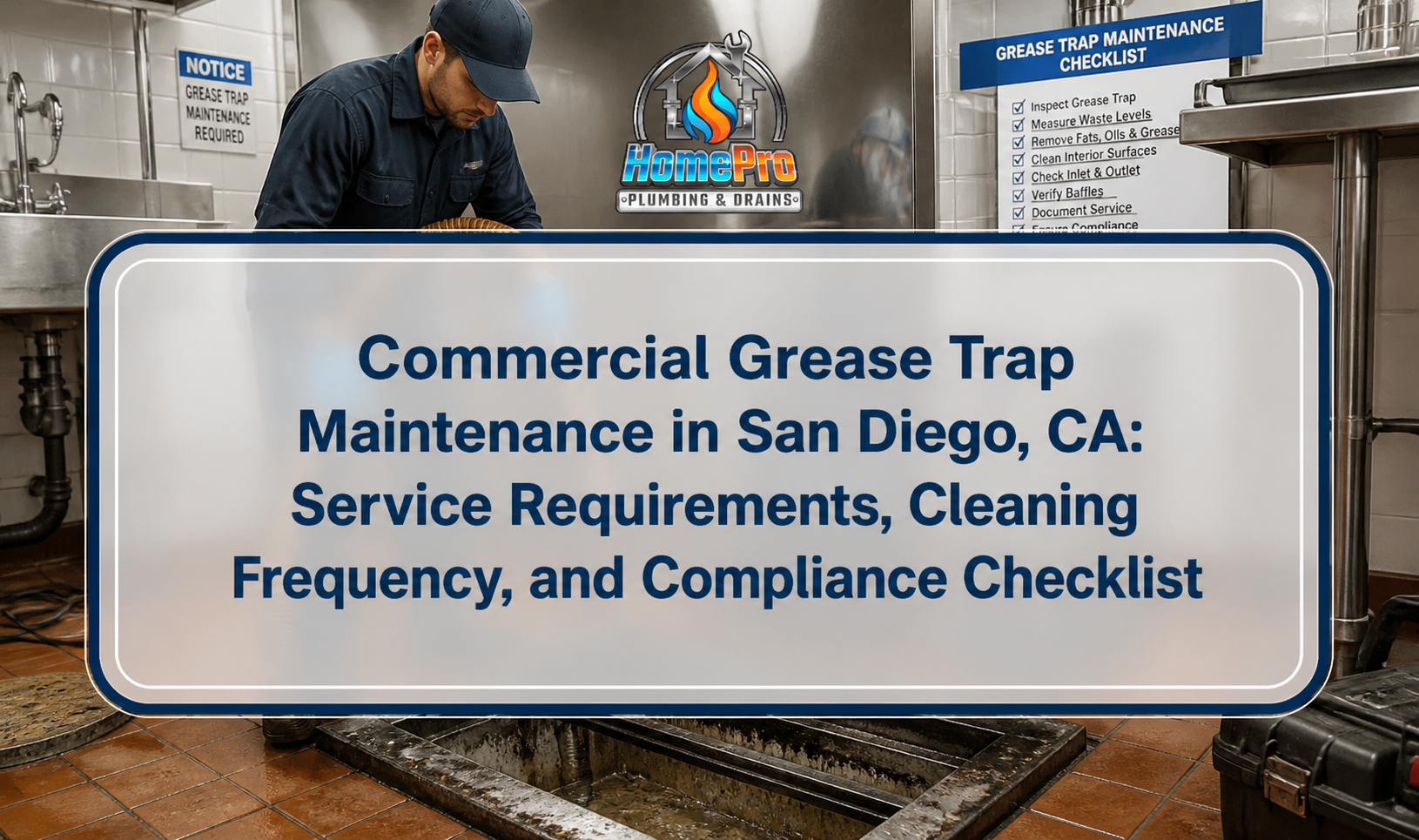
Commercial grease trap maintenance in San Diego is most predictable when it follows a repeatable workflow—measure grease/solids, remove contents, clean and inspect components, and document each visit. A defensible cleaning cadence is based on measured accumulation and servicing before the combined grease cap and settled solids reach about 25% of the unit’s liquid capacity.
- Complete service workflow: Proper maintenance is more than “pump and go” and typically includes measuring levels, pumping/controlled removal, scraping and rinsing interior surfaces without flushing FOG into drains, inspecting inlet/outlet tees and baffles, reassembling correctly, and leaving a documented service record and disposal paperwork when applicable.
- Measurement-based cleaning frequency: Start with a conservative interval and adjust based on logged grease and solids readings over 2–3 cycles, because trap size, kitchen volume, menu type, and operational habits can change how quickly the unit reaches the 25% rule threshold.
- Escalation when symptoms persist: If odors return within days, slow drains continue, or the unit hits 25% unusually fast, the issue may be residual sludge, damaged parts, plumbing configuration problems, or grease-coated downstream lines—so diagnostics may be needed rather than only increasing pumping frequency.
Commercial grease trap maintenance San Diego is required to keep fats, oils, and grease (FOG) from entering the sewer system and to help food service facilities stay aligned with local wastewater and pretreatment expectations. Proper service typically includes measuring grease and solids levels, pumping and hauling contents, scraping and rinsing the interior, inspecting inlet/outlet tees and baffles, and restoring the unit to normal operating condition with a documented service record.
In practice, cleaning frequency is driven by trap size, kitchen volume, menu type, and the “25% rule” commonly used in the industry (service before combined grease and solids exceed about a quarter of the interceptor’s capacity). Skipping maintenance can lead to backups, odors, slow drains, and potential violations tied to FOG discharge limits, so consistent scheduling and accurate manifests/logs matter.
This guide breaks down typical service requirements, how to set a defensible cleaning cadence, and a compliance checklist covering inspection points, recordkeeping, and best practices for safe handling and disposal.
What “Commercial Grease Trap Maintenance” Typically Includes
Commercial grease trap maintenance in San Diego usually follows a repeatable service workflow: verify current FOG levels, remove contents, clean internal surfaces, inspect key components, and document the visit for operations and compliance.
Whether you have a small under-sink grease trap (often called a grease “trap”) or a larger outdoor grease interceptor, the goal is the same: keep FOG and settleable solids from migrating downstream into building drains and the public sewer. A proper maintenance visit is more than “pump and go”—it should leave the unit returned to normal operating condition and ready for predictable performance.
- Access and safety setup (confirm lid condition, ventilation, and safe entry area)
- Measure grease and solids thickness (to evaluate the “25% rule” threshold)
- Remove contents via pumping or manual removal depending on trap type
- Scrape and rinse interior walls, lid, and piping interfaces (without flushing FOG into drains)
- Inspect inlet/outlet tees, baffles, gaskets, and lid fit
- Reassemble correctly (properly seated lid, intact seals, correct flow path)
- Recordkeeping (date, volumes/levels, condition notes, hauler/manifests as applicable)
Because equipment designs vary, maintenance should also confirm that the unit matches how your kitchen is actually used. For example, high-volume wok cooking, frying, or heavy dairy/cheese use can load an interceptor far faster than a limited-menu café—even when the trap is the “right” size on paper.
Grease Trap vs. Grease Interceptor: Why the Difference Matters
Trap type affects cleaning methods, downtime, and how quickly FOG accumulates—so identifying what you have is the first step in setting a defensible schedule.
Smaller indoor units are often placed close to fixtures and fill quickly, while larger interceptors are typically outside and sized to buffer higher flows. Both can fail if not serviced, but they tend to fail in different ways (rapid blockage vs. gradual pass-through of emulsified grease).
| System / Consideration | What It Typically Means | Operational Notes for San Diego Kitchens |
|---|---|---|
| Indoor grease trap (point-of-use) | Compact unit serving one or a few fixtures; faster accumulation and more frequent cleaning. | Plan for frequent service windows and staff coordination because access is often inside prep areas. |
| Outdoor grease interceptor | Larger capacity tank serving multiple fixtures; pumped/hauled by a permitted waste hauler. | Keep lids secure and accessible; schedule pumping to avoid overflow odors and pass-through. |
| The “25% rule” service trigger | Service before combined grease + solids exceed ~25% of the unit’s liquid capacity. | Document measurements to justify cadence if questioned by landlords, auditors, or inspectors. |
| Pass-through risk | When retention time drops, FOG moves downstream instead of separating. | High-flow events (dishwashers, mop sinks) can spike pass-through if plumbing isn’t configured correctly. |
| Component condition (baffles/tees) | Damaged or missing internal parts reduce separation performance dramatically. | Include component checks in every visit; replacement needs are common after repeated lid removals. |
How to Set a Cleaning Frequency You Can Defend
The best cleaning cadence is one you can justify with measurements, kitchen behavior, and consistent records—not a one-size-fits-all interval.
Many facilities start with a conservative schedule (for example, monthly for small traps or quarterly for larger interceptors) and then adjust based on measured grease/solids accumulation and operational changes. The “25% rule” is widely used as a practical decision tool, but it still requires you to measure, not guess.
Use the “25% Rule” Without Turning It Into a Guess
To apply the 25% rule correctly, measure grease thickness and settled solids, estimate the combined percentage of the unit’s capacity, and schedule service before it crosses the threshold.
- Measure FOG layer at the top (grease cap thickness)
- Measure settled solids at the bottom (sludge thickness)
- Add them together and compare to the liquid depth/capacity
- Track the trend over 2–3 service cycles to confirm your true accumulation rate
If you don’t know the unit’s capacity or the liquid depth changes with operating conditions, your vendor can help document a baseline. That baseline—plus consistent measurements—becomes your strongest defense if an issue is later traced to FOG discharge or drain line blockage.
Variables That Change Maintenance Needs (Sometimes Overnight)
Kitchen volume and menu are obvious drivers, but staffing, equipment, and habits can shift accumulation rates just as much as sales do.
- Menu changes: more frying, rendered meats, cheese-heavy prep, and sauces can increase FOG loading.
- Dishwashing patterns: dumping warm, greasy water quickly can push emulsified fats downstream.
- Pre-rinse behaviors: scraping plates into trash/compost vs. rinsing into sinks can be the difference between stable drains and constant clogs.
- Equipment additions: adding a prep sink, wok station, or combi oven condensate line may increase inflow to the interceptor.
- Seasonality: busy tourist periods and catering seasons can compress your service window.
Any time you see new odors, slow drainage, or recurring line blockages, treat it as a signal that your schedule may be too light—or that the trap is being bypassed or overwhelmed.
Step-by-Step: What a Proper Cleaning Visit Looks Like
A complete service should remove FOG and solids, restore separation performance, and leave behind clear documentation for managers, landlords, and inspectors.
The exact workflow depends on whether you have an indoor trap (often cleaned more frequently with smaller volumes) or an outdoor interceptor (typically pumped and hauled). Either way, the technician should be able to explain what was removed, what condition the unit was in, and what needs attention next cycle.
- Confirm access and isolate the work area to reduce splash risk and keep food prep zones protected.
- Open the lid and evaluate conditions (odor, excessive grease cap, evidence of bypassing, damaged parts).
- Measure grease and solids layers and log readings before disturbing contents.
- Remove contents using pumping/hauling for interceptors or controlled removal for smaller traps.
- Scrape interior surfaces (walls, lid underside, baffles/tees) so residual FOG doesn’t rapidly re-seed.
- Rinse appropriately to remove remaining residue without flushing grease into building drains.
- Inspect internal components and verify flow path integrity (inlet/outlet alignment matters).
- Reassemble and confirm normal operation (lid seated, gasket intact, no leaks at seams).
- Provide documentation including date/time, observations, and disposal/hauling records when applicable.
Be cautious of “partial pump-outs” that remove liquid but leave thick sludge behind, because remaining solids can shorten the next cycle and reduce separation efficiency. If the unit is consistently returning to 25% too quickly, it may indicate undersizing, incorrect plumbing configuration, or poor upstream practices.
Compliance and Documentation Checklist (What to Keep On-Site)
Good logs and manifests help show consistent management of FOG and can reduce confusion during inspections or property audits.
San Diego-area requirements can vary by jurisdiction (city vs. county vs. special districts) and by permit conditions, so it’s smart to keep a simple, consistent record system that stands on its own. When in doubt, keep more documentation rather than less.
- Service reports with date/time, measured levels, and unit condition notes
- Pumping/hauling manifests (for interceptors) that identify the hauler and disposal pathway
- Maintenance schedule (planned dates and any reschedules with reason)
- Repair records (baffle/tee replacement, lid resealing, cracked tank repairs)
- Kitchen BMP training notes (what staff were instructed to do and when)
- Photos when useful (before/after condition, damaged components, unusual buildup)
Documentation is also operationally useful: if a manager changeover happens or a landlord asks for proof of maintenance, you can provide it quickly. This can be especially important in multi-tenant food courts where responsibility for shared interceptors can be disputed.
Common Problems That Show Up During Grease Trap Maintenance
Many “grease trap failures” are actually plumbing configuration issues, damaged internal parts, or kitchen habits that overwhelm the device.
Finding these early keeps your maintenance spend predictable and reduces the risk of backups during service hours. It also helps avoid repeated emergency cleanups that only treat the symptom.
Mechanical Issues Inside the Unit
Broken or missing internal components can cause FOG to flow straight through, even if pumping is happening on schedule.
- Missing/damaged baffles that prevent proper separation
- Cracked inlet/outlet tees that allow short-circuiting
- Warped lids or failed gaskets that allow odors and pests
- Corrosion or structural wear (more likely in older metal traps)
Upstream and Downstream Plumbing Issues
Slow drains and backups may persist even after a clean trap if lines are already coated with grease or obstructed by solids.
- Grease-coated branch lines from years of FOG carryover
- Improper fixture connections (for example, fixtures tied in that shouldn’t be)
- Ventilation or flow problems causing poor drainage and trap turbulence
- Partial blockages downstream that create backpressure through the interceptor
When symptoms point to line restrictions, professional drain cleaning may be the next step to restore full flow and reduce recurring grease trap overload.
Best Practices to Reduce FOG Loading Between Cleanings
Kitchen best practices (BMPs) reduce how much grease enters the system, which can extend intervals and decrease odors and emergencies.
Maintenance vendors can remove what’s already in the unit, but day-to-day behaviors determine how fast it refills. The best BMPs are simple, trainable, and easy to audit during shift changes.
- Dry-wipe before washing (use scrapers and paper towels before rinsing)
- Use sink strainers to capture solids before they enter the drain
- Dispose of fryer oil properly via an oil recycling service (never down a mop sink)
- Control temperature shocks (very hot discharge can keep fats emulsified and moving downstream)
- Post simple signage above dish and prep sinks for new staff
- Avoid enzymes/chemicals marketed as “grease eliminators” if they encourage flushing FOG; they may move grease past the interceptor rather than removing it
Also evaluate what’s connected: if fixtures like mop sinks, dishwashers, or floor drains are routed into a system in a way that creates turbulence, it can reduce separation time. If you suspect configuration issues, a targeted investigation may be warranted before increasing pumping frequency.
When to Escalate Beyond Routine Maintenance
If you’re seeing repeated backups, strong odors shortly after service, or unexplained slow drains, you may need diagnostics rather than just more frequent pumping.
Routine grease trap maintenance is preventive, but it can’t fix collapsed pipes, severe grease scaling in long runs, or misconfigured connections. Escalation is often faster and cheaper than reacting to repeated “mystery clogs.”
- Odors return within days (could indicate residual sludge, damaged seals, or venting issues)
- Trap hits 25% unusually fast (undersized unit, increased kitchen output, or solids entering at high volume)
- Frequent slow drains in multiple fixtures (downstream restriction likely)
- Overflows or backups during peak hours (flow exceeds separation capacity or line is partially blocked)
In these cases, a visual inspection of the drain and sewer pathways can clarify what’s happening inside the pipe. For deeper troubleshooting, a sewer camera video inspection can help confirm whether grease buildup, roots, offsets, or other defects are contributing to repeat issues.
If you want to understand how professionals pinpoint hidden plumbing issues in general, see how plumbers detect hidden leaks—many of the same diagnostic principles (verification, isolation, and confirmation) apply when tracing intermittent drainage problems.
Safety, Handling, and Disposal: What Facilities Should Know
Grease trap waste is messy and can be hazardous; safe handling protects staff, customers, and the building while helping ensure disposal is done responsibly.
Most kitchens should avoid DIY cleanouts beyond surface skimming and strainer maintenance, because improper handling can spread contamination, damage seals, or push grease into the sewer. Disposal and hauling practices can depend on unit size and site setup, so coordinate with a qualified service provider and keep the paperwork.
- Keep staff away from open interceptors during service and block off the area.
- Do not hose grease into floor drains as a “shortcut” cleanup method.
- Use appropriate PPE for anyone near splashes (gloves/eye protection as a baseline).
- Confirm waste is transported and disposed of properly with supporting manifests when applicable.
Grease systems sit within a broader plumbing environment that includes potable water lines, drainage, and venting. If you’re mapping responsibilities across plumbing systems, a general overview of plumbing can help clarify how these subsystems interact and why a downstream restriction can show up as a grease trap symptom.
Keeping Grease Trap Maintenance Predictable in San Diego
The most reliable results come from a measured cadence, consistent cleaning methods, and documentation that matches how your kitchen actually operates.
Commercial grease trap maintenance in San Diego is easiest to manage when you treat it as a process: measure levels, service before the 25% threshold, track trends, and correct upstream behaviors that accelerate buildup. When problems persist after cleanings, shift from “more pumping” to diagnostics so you can address root causes like downstream restrictions or component failures.
With a clear schedule, trained staff BMPs, and complete records, grease control becomes routine instead of reactive—reducing odors, backups, and disruption during service hours.
Frequently Asked Questions
Keep Your Grease Trap on a Measured, Documented Maintenance Schedule
If your kitchen is dealing with odors, slow drains, or uncertainty about the right pump-out interval, a consistent maintenance plan can help you stay ahead of FOG buildup while keeping clear records for managers, landlords, and inspectors. The right cadence is based on actual grease and solids measurements—not guesses—so your service schedule matches real kitchen volume and menu demands.
Working with a plumbing and drain professional can also help confirm the unit’s condition (baffles, tees, lids, and seals) and flag downstream line issues that can cause repeat backups even after cleanouts.
Related Posts
Water Softener Installation and Repair in San Diego, CA: Costs, Options, and What to Expect
Key Takeaways Effective water softener installation and repair in San Diego starts with confirming that…

Water Filtration System Installation in San Diego, CA: Costs, Permits, and What to Expect
Key Takeaways Water filtration system installation San Diego homes typically goes smoothly when the system…