


Gas Line Repair for Commercial Buildings in San Diego, CA: Code-Compliant Fixes, Emergency Response, and Inspection Readiness
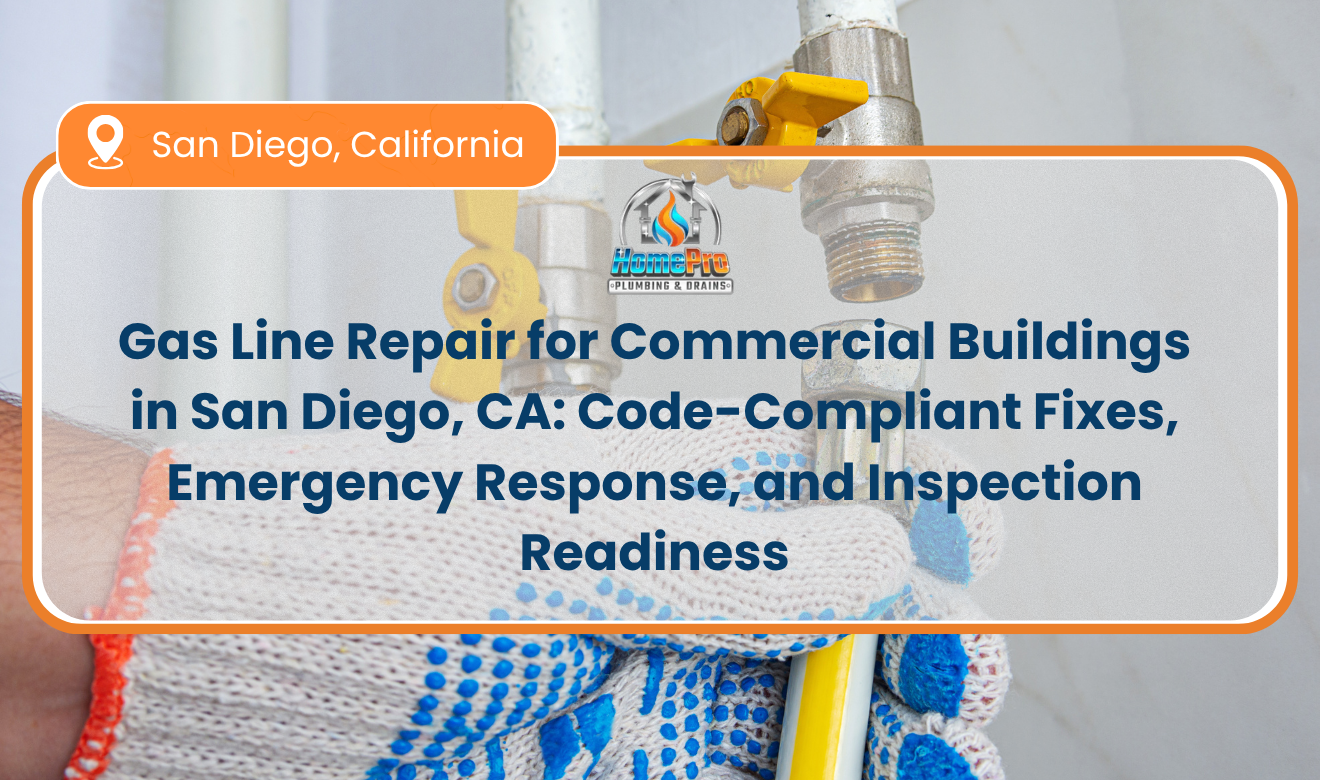
Gas line repair for commercial building San Diego is resolved by isolating the affected piping, correcting the defect with code-approved materials and installation details, then completing and documenting a compliant pressure test so the system can be safely restored and pass inspection without rework.
- Most Repairs Start with Proof and Isolation: Commercial gas corrections are typically triggered by confirmed leaks, inspection findings, or load-related pressure drop and are addressed fastest when the problem branch is instrument-located and isolated without shutting down unaffected areas.
- Inspection-Ready Means More Than “No Leak”: San Diego pass/fail outcomes often hinge on visible compliance items like accessible shutoffs, correct sediment traps where required, proper pipe support, protected rated penetrations, and correct regulator venting and clearances.
- Testing and Documentation Drive Sign-Off: A properly isolated air/inert pressure test with a readable gauge, code-appropriate hold time, and recorded results is the documentation backbone inspectors expect before service restoration and appliance restart.
Gas line repair for commercial building San Diego is the code-compliant inspection-ready correction of leaking, damaged, undersized, or improperly installed fuel-gas piping serving business occupancies. Work typically starts with isolating the affected branch, locking out appliances, and verifying zero pressure before opening piping. Common San Diego callouts include a restaurant kitchen with a flexible connector kinked behind a range, a rooftop HVAC gas whip cracked by UV exposure, or a tenant improvement where a new fryer was tied into an undersized 1/2-inch branch that drops pressure under load. Repairs often require replacing corroded black steel, rethreading joints, correcting sediment trap and shutoff valve placement, and properly supporting pipe at code-required intervals to prevent movement at elbows and unions. Emergency response focuses on rapid leak localization using calibrated combustible gas detection at valves, meter sets, and appliance regulators, followed by controlled shutoff and ventilation to reduce ignition risk. Inspection readiness in San Diego typically means documented pressure testing of the affected section, verification of regulator venting and appliance clearances, and visible compliance items such as accessible shutoff valves within reach of equipment, approved fittings, and protected penetrations through rated walls.
What Triggers Commercial Gas Piping Repairs in San Diego
Most commercial repairs start because a leak was detected, an inspector flagged a code issue, or new equipment caused pressure drop on an existing branch line. In San Diego, the highest-frequency triggers show up during tenant improvements, kitchen appliance swaps, rooftop unit replacements, and routine safety checks.
Typical repair drivers include:
- Confirmed leak at a threaded joint, union, valve stem packing, appliance regulator, or flexible connector.
- Mechanical damage from impacts, vibration, settling, or poor pipe support that loads elbows and tees.
- UV and weather exposure degrading rooftop appliance connectors/whips or non-rated coverings.
- Improper sizing where added appliances overload a branch, producing low manifold pressure, delayed ignition, nuisance lockouts, or flame rollout risk at equipment.
- Noncompliant installation details such as missing sediment traps at appliances where required, inaccessible shutoff valves, or unprotected penetrations through rated assemblies.
Codes and Authorities That Govern Fuel-Gas Work
Commercial fuel-gas repairs in San Diego must align with California’s adopted building standards and local enforcement practices. The controlling requirements typically come from the California Plumbing Code (CPC) and the California Mechanical Code (CMC), as adopted and enforced by the local Authority Having Jurisdiction (AHJ).
For an inspection-ready outcome, a contractor will normally verify and document compliance with:
- California Plumbing Code (CPC) requirements for fuel-gas piping materials, fittings, valves, testing, and identification.
- California Mechanical Code (CMC) requirements that affect gas-fired appliances, combustion air, venting, equipment clearances, and mechanical room conditions.
- California Building Code (CBC) provisions relevant to penetrations through fire-resistance-rated assemblies and seismic bracing/anchorage where applicable.
- Utility company requirements (e.g., meter/regulator set practices, lock-off procedures, and service restoration rules), which often govern who can operate certain valves and when service can be re-energized.
Because commercial occupancies vary (restaurants, medical, lab, retail, mixed-use), repair plans should be written to the actual occupancy and equipment schedule, not generic residential assumptions.
Immediate Safety Actions When a Gas Odor or Alarm Occurs
When there is an active odor complaint or detector activation, the priority is ignition-risk reduction and controlled isolation. The correct sequence is ventilation, elimination of ignition sources, and systematic shutdown consistent with site emergency procedures and utility rules.
Operationally, the response should follow a documented safety workflow:
- Evacuate/clear the affected area per the facility’s emergency action plan.
- Do not operate electrical switches in the suspected area; avoid actions that can create a spark.
- Ventilate by opening exterior doors where feasible and safe to do so.
- Isolate the fuel source using the nearest safe, accessible shutoff (appliance valve, branch valve, or meter-area shutoff when permitted).
- Verify atmosphere using calibrated combustible gas detection and re-check after isolation.
- Lock out/tag out appliances so equipment is not restarted until the system is repaired, tested, and cleared.
If gas is suspected inside a confined area, locating the source with instruments (rather than “sniff testing”) is the professional standard because it documents conditions and reduces time-to-isolation.
Professional Diagnostic Workflow for Leak Localization
Accurate leak localization depends on instrumented detection plus targeted isolation of branches and appliances. In commercial settings, diagnostics must also protect operations by minimizing downtime and avoiding unnecessary shutdown of unaffected tenants.
A code-aligned diagnostic approach commonly includes:
- System mapping of meter/regulator, manifold, branches, and appliance drops to define isolation points.
- Instrument survey at high-probability leak points:
- Meter set/regulator and vent lines
- Appliance shutoff valves and valve packing
- Unions, drip legs, sediment traps
- Roof penetrations and rooftop equipment whips
- Equipment connectors behind ranges, ovens, fryers, and boilers
- Bubble solution confirmation at suspect joints after instrument indication, ensuring the surface is clean and accessible.
- Sectional isolation to narrow the leak to a branch (for multi-tenant and multi-appliance systems).
When a building has repeated pressure issues (not just a leak), validation shifts to load analysis: verifying connected BTU demand, pipe lengths, fittings-equivalent lengths, regulator setpoint, and appliance inlet pressure under simultaneous operation.
Common Repair Scenarios and Code-Critical Fixes
Most commercial corrections fall into a small set of repeatable repairs: replacing failed connectors, reworking threaded steel, resizing branches, and restoring required valves/traps/supports. The difference between “fixed” and “inspection-ready” is whether the work also corrects accessibility, support, and testing documentation.
Frequent San Diego commercial repair items include:
- Flexible connector replacement for kinks, over-length, improper routing, or damage behind cooking equipment.
- Rooftop gas whip replacement where UV exposure or vibration has degraded or cracked components.
- Black steel pipe replacement/rethreading when corrosion, cross-threading, or over-tightened fittings compromise joint integrity.
- Valve corrections to ensure each appliance has an accessible shutoff valve within reach of the equipment location (as required by code and inspection practice).
- Sediment trap (drip leg) corrections where required by appliance listing/instructions and prevailing inspection standards.
- Pipe support corrections to prevent movement, joint stress, and long-term loosening at elbows/unions.
- Branch resizing when added appliances produce measurable pressure drop under load.
Material and connection method must match the application and code acceptance (e.g., appropriate steel pipe and listed fittings; listed CSST where permitted and installed to manufacturer instructions; bonding/grounding where required by applicable standards and manufacturer requirements).
Pressure Testing and Documentation That Inspectors Expect
Inspection readiness typically hinges on a proper pressure test of the affected piping section and clear documentation of the results. In San Diego, field inspectors commonly look for a visible test gauge setup, isolation from appliances as required, and a recorded test duration and pressure.
A compliant testing workflow generally includes:
- Isolate the test section so the test does not damage appliance regulators or controls.
- Use an appropriate test medium (commonly air or inert gas as allowed); never pressure-test with fuel gas.
- Install a calibrated gauge with a readable scale suitable for the test pressure range.
- Hold test pressure for the code-required duration for the scope of work and piping size/volume.
- Record results (pressure, start/end time, ambient conditions if relevant, and what section was tested).
Inspectors may also verify that appliance startup is performed safely after the test, including leak-check at connections that were disturbed and confirmation that pilots/ignition systems and combustion settings operate normally.
San Diego Inspection-Ready Checklist for Commercial Fuel-Gas Repairs
An inspection-ready job is one where the repair is complete, visible compliance items are in place, and the test/permit trail matches the work performed. This reduces reinspection risk and helps restore service faster.
Use this field checklist to align the final condition with common AHJ expectations:
- Access: Appliance shutoff valves are accessible without moving the appliance in a way that violates safety or listing.
- Protection: Piping is protected from physical damage in traffic/storage areas and at penetrations.
- Support: Pipe is supported at required intervals and near changes in direction to reduce stress.
- Penetrations: Rated wall/floor penetrations are properly sealed with approved firestopping methods where required by CBC.
- Regulators: Regulator venting is installed per manufacturer requirements and terminated appropriately.
- Clearances: Appliance clearances and service access are maintained; no heat damage risk to connectors/valves.
- Labeling/identification: Where required, piping identification and valve tagging match facility standards.
- Test proof: Pressure test performed and documented for the repaired/altered section.
Commercial Repair Metrics and Local Practice Reference
The table below consolidates the key technical checkpoints that most often affect pass/fail outcomes and operational safety. Use it to align repair scope, testing, and inspection prep with common San Diego enforcement patterns.
| Feature / Metric | Specifications | Local Guidelines |
|---|---|---|
| Leak confirmation method | Instrumented combustible gas detection followed by bubble solution confirmation at joints/valves | Documented localization supports faster approval and reduces “no leak found” call-back risk |
| Pressure test readiness | Isolate appliances; use air/inert gas; readable gauge; hold per CPC requirements applicable to the work scope | Inspectors commonly verify gauge visibility, isolation from equipment, and recorded start/stop times |
| Shutoff valve placement | Accessible valve serving each appliance/equipment connection, installed to code and listing instructions | Accessibility is a frequent correction item in restaurant and TI inspections |
| Branch sizing / pressure drop | Size based on total BTU load, developed length, fitting equivalents, and allowable pressure drop; verify inlet pressure under load | TI work that adds appliances often triggers resizing corrections before final sign-off |
| Rooftop exposure durability | Components suitable for UV/weather and supported to limit vibration-induced fatigue | Coastal conditions and rooftop UV commonly drive premature failures if materials are mismatched |
How to Reduce Downtime in Restaurants and Multi-Tenant Buildings
Downtime is minimized by isolating only the affected branch, staging parts before shutdown, and coordinating inspection windows. In practice, the best results come from doing the investigative work first, then performing a short, controlled outage to execute the actual cut-in.
Operational steps that reduce business interruption:
- Pre-stage materials (correct pipe/fittings/valves/connectors) after measuring in the field.
- Plan isolation at the nearest upstream valve that preserves service to other tenants/equipment.
- Coordinate appliance lockout so staff cannot restart equipment during repair/testing.
- Schedule pressure test and inspection to avoid extended “gas off” periods awaiting approvals.
- Perform startup verification after restoration: leak check, confirm burner ignition stability, and verify no alarms.
If the facility also struggles with intermittent odors, water intrusion, or unexplained utility impacts that complicate troubleshooting, pairing fuel-gas repairs with targeted commercial leak detection can help document conditions and narrow root causes across building systems.
When a “Repair” Should Become a System Upgrade
Some situations require more than replacing a fitting; they require redesign to eliminate chronic pressure drop and repeated leak points. The upgrade decision is driven by measurable capacity limits, repeated failures, or code/inspection barriers that cannot be solved with a localized patch.
Escalate from repair to upgrade when you have:
- Repeated leaks in the same branch due to vibration, movement, or inadequate support.
- Documented pressure drop under simultaneous load after new appliances were added.
- Noncompliant routing through rated assemblies or areas requiring protection that can’t be achieved with minor correction.
- Rooftop equipment expansions where multiple whips and add-ons increase failure points.
In many commercial buildings, coordinated upgrades are also an opportunity to improve maintainability: add proper isolation valves by zone, create clear service access, and standardize connector types and protection methods.
What Property Managers Should Document for Compliance and Risk Control
Commercial occupancies benefit from a written record that ties the repair to a test result and a final condition check. This is useful for inspections, insurance questions, and internal safety audits.
Minimum recommended documentation packet:
- Scope description: what was leaking or noncompliant, and what was replaced/relocated/resized.
- Photos: before/after of joints, valves, sediment traps, supports, penetrations, and rooftop connections.
- Pressure test record: test medium, gauge type/range, pressure, duration, and what portion of piping was tested.
- Appliance list: equipment served, BTU ratings (from nameplates), and any regulators involved.
- Service restoration checklist: leak-check verification and safe startup confirmation.
For a broader look at service-call sequencing and what technicians typically check once onsite, reference what to expect during a plumbing service call; many of the jobsite documentation and access principles overlap even though fuel-gas work has stricter isolation and testing controls.
Fuel-Gas Repairs in the Bigger Building-Systems Context
Commercial gas piping should be evaluated as part of a building’s full mechanical and plumbing ecosystem, not as a standalone line. That includes how combustion air, ventilation, and appliance operation interact with the broader plumbing infrastructure.
Building operators benefit from understanding how fuel-gas safety fits into the larger discipline of plumbing, including permitting, inspection cycles, and risk controls that keep systems reliable under daily operational loads.
Inspection-Ready Results: The Practical Standard in San Diego
A successful commercial gas repair restores safe operation and passes inspection without rework by combining correct materials, correct placement, and documented testing. The most consistent outcomes come from treating every leak fix as a compliance event: isolate, correct, test, verify, and document.
To reach an inspection-ready finish line, ensure the final deliverables include:
- Corrected defect (leak eliminated or capacity restored) with approved materials and workmanship.
- Visible compliance items (accessible shutoffs, proper support, protected penetrations, sediment traps where required).
- Pressure test evidence matched to the altered section and performed with proper isolation.
- Safe restoration (post-repair leak check, controlled appliance restart, and stable operation under load).
This is the operational definition of code-compliant, inspection-ready commercial gas line repair in San Diego: not just stopping the leak today, but preventing repeat failures and avoiding inspection delays tomorrow.
Frequently Asked Questions
Stop the Leak — And Stop the Next Shutdown Before It Happens
Commercial gas piping problems don’t “kind of” fail. They fail fast—during a dinner rush, mid-tenant improvement, or right before an inspection—when a small leak, kinked connector, or undersized branch turns into a full shutdown, an evacuation, lost revenue, and a failed sign-off you didn’t budget time for.
And here’s the hard truth: trying to patch it yourself or hiring a non-specialist usually makes it worse. Miss one hidden leak point, skip proper isolation, reinstall a connector that’s not rated for the application, or guess at sizing—and you’re inviting repeated odor complaints, nuisance lockouts, unstable ignition, and inspectors who keep finding “just one more correction.” In commercial buildings, that doesn’t just cost money. It creates real safety exposure for staff, customers, and tenants.
What you want is an inspection-ready fix: leak localized with calibrated detection, repairs done with approved materials and correct support/valve/trap placement, and pressure testing documented so the AHJ can sign off without delays. That’s how you restore service faster and avoid the next surprise shutdown.
Related Posts
Sewer Backup Plumber in San Diego, CA: Fast Diagnosis, Cleanup, and Lasting Repair Solutions
Executive Summary A sewer backup in San Diego is definitively resolved by stopping incoming water,…
Clogged Drain Plumber in San Diego, CA: Fast, Reliable Drain Clearing and Repair Service
Executive Summary A clogged drain plumber in San Diego resolves recurring or severe drain issues…