



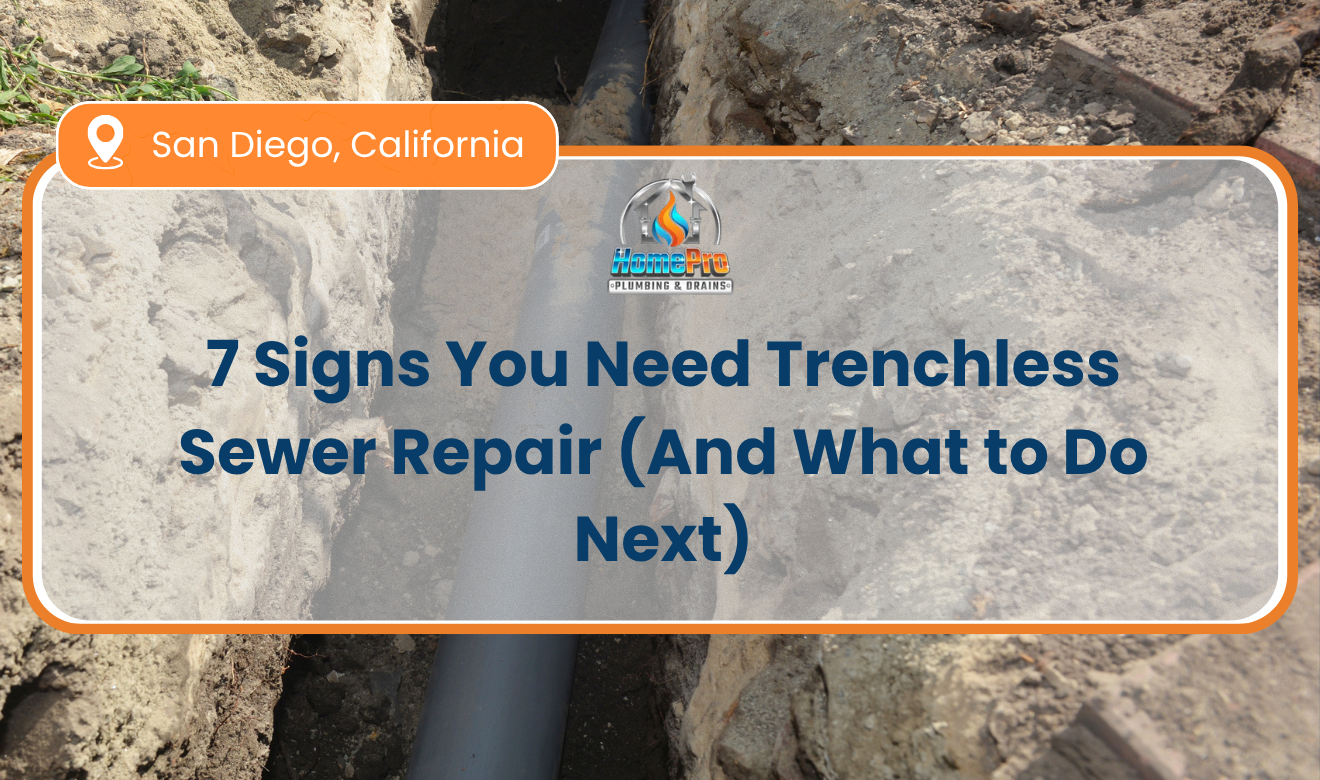
7 Signs You Need Trenchless Sewer Repair (And What to Do Next)
Executive Summary
Persistent multi-fixture slow drains, recurring backups, sewer odors, gurgling, and yard saturation are most often caused by a measurable defect in the sewer lateral—not a one-time clog. The definitive path to resolution is a recorded, distance-marked sewer camera inspection followed by the correct trenchless method (CIPP lining for sealable defects or pipe bursting/replacement for structurally failed sections).
Core Insights
- Repeatable, Multi-Fixture Symptoms Signal Mainline Failure: When multiple drains slow down together or backups return soon after snaking, the root cause is commonly a structural restriction (roots, offsets, scale, cracks) that cleaning alone cannot permanently solve.
- Camera Documentation Determines the Correct Trenchless Path: A proper inspection measures defect type and distance, verifies a continuous bore, and identifies bellies or collapse—criteria that decide whether lining is feasible or replacement is required.
- Match the Method to the Defect to Avoid Wasted Spend: CIPP lining seals cracks/joints and blocks root entry after cleaning, while crushed, severely offset, or near-collapsed pipe typically requires trenchless replacement (often via pipe bursting) or localized grade correction.
Signs You Need Trenchless Sewer Repair are specific, repeatable symptoms that point to a failing underground sewer line that can often be fixed without full excavation. Sewage odors that linger near a cleanout cap, a basement floor drain, or a laundry standpipe often indicate escaping sewer gas from a cracked or separated pipe joint. Slow drains in multiple fixtures at the same time, such as a tub, toilet, and kitchen sink, usually signal a mainline restriction rather than a single branch clog. Gurgling sounds after a toilet flush can mean air is trapped by a partial blockage or a sagging “belly” in the line. Recurring backups that return weeks after snaking can indicate root intrusion at joints, common in older clay or cast-iron laterals, especially near large street trees. Wet patches or sudden settling in the yard above the sewer route can point to a collapse, a shifted fitting, or a washed-out trench line. Unexplained spikes in water bills combined with soggy soil can also appear when a compromised sewer allows groundwater infiltration that overloads the system during rain. The next step is a camera inspection through an accessible cleanout to document the exact defect type, depth, and distance, then confirm the best trenchless option, such as cured-in-place lining for cracks and roots or pipe bursting for severely crushed sections.
What “Trenchless” Actually Means for a Failing Sewer Lateral
Trenchless sewer work repairs or replaces an underground pipe through small access points instead of a full-length trench. In most homes, it targets the private sewer lateral from the building to the public main, plus any segments under slabs, patios, or landscaping.
In practical terms, trenchless methods depend on two things:
- Access: a ground-level cleanout, roof vent access, or a small excavated entry/exit pit.
- Documented pipe condition: a camera inspection that confirms whether the line is cracked, root-intruded, offset, bellied, or collapsed.
If you’re seeing persistent sewer symptoms, the fastest way to validate the defect (and avoid unnecessary digging) is a documented video inspection. Scheduling a sewer camera video inspection is the standard first step before any lining or bursting plan is approved.
High-Confidence Warning Signs That Point to Mainline Failure (Not a Simple Clog)
Repeatable patterns across multiple fixtures and locations are the strongest indicators of a compromised main sewer line. These signs tend to recur even after snaking because the underlying defect remains.
Use the checklist below to separate “one-drain” problems from mainline problems:
- Multiple fixtures draining slowly at once (toilet + tub + kitchen): typically indicates restriction in the building drain or sewer lateral.
- Backups that return after normal cabling: often caused by roots entering through joints, pipe scale, or a structural defect (offset joint, crack).
- Sewer odor near cleanouts or basement drains: can indicate a broken line, separated joint, or dried trap; persistent odor outdoors near the lateral route is more consistent with pipe failure.
- Gurgling after flushing: suggests air displacement from partial blockage, belly, or venting issues; when combined with slow drains, mainline restriction is likely.
- Wet patches or soil settlement above the sewer route: may indicate leakage, a washed-out trench, or a developing collapse.
- Backflow through the lowest drain (floor drain, shower, first-floor toilet): common when the mainline can’t pass peak discharge.
These are the most reliable signs you need trenchless sewer repair because they correlate with a physical defect in the underground line—not just a temporary obstruction.
Defect Types That Trenchless Methods Commonly Fix (and When They Don’t)
Trenchless repair is most effective when the pipe pathway is still passable and the defect can be measured and isolated by camera. Fully collapsed lines or severely misaligned segments may require replacement, often still achievable via trenchless pipe bursting.
Typical defect-to-solution mapping looks like this:
- Cracks and small fractures: often addressed with cured-in-place pipe (CIPP) lining if the pipe can be cleaned and holds shape.
- Root intrusion at joints: lining can seal joints after root removal; recurring roots without sealing generally return.
- Offset joints (pipe sections shifted): lining may work if the offset is minor and the liner can pass; significant offsets often push the plan toward bursting or spot excavation.
- Belly (sag): lining does not correct grade; a belly that holds water is commonly corrected by excavation of that section or by replacement methods that reestablish slope.
- Heavy corrosion/scale in cast iron: cleaning + lining is common if wall loss is not advanced; if the pipe is structurally compromised, replacement is safer.
- Crushed or collapsed pipe: typically requires replacement; pipe bursting is often chosen to avoid full trenching.
Camera documentation should capture: pipe material (clay, cast iron, ABS/PVC), internal diameter, defect location (distance from cleanout), and whether the line maintains a continuous bore.
How a Camera Inspection Confirms the Diagnosis (Step-by-Step)
A sewer camera inspection is a measurement process, not just a “look around.” A proper inspection records the exact distance to each defect and identifies whether trenchless lining or bursting is technically feasible.
Standard inspection workflow includes:
- Locate and open an accessible cleanout (or create one if needed for safe access and future maintenance).
- Run a video camera to the city connection (or until the obstruction/termination point is reached).
- Record distances using the camera’s footage counter to tag defects (example: “crack at 34 ft”).
- Identify defect category: roots, crack, separated joint, belly, intrusion, collapse, scale.
- Optional locating: use a transmitter sonde to mark the line depth and route from above for accurate access planning.
- Verify flow conditions: standing water indicates belly; muddy water can indicate active infiltration and soil intrusion.
For homeowners trying to understand why backups keep returning, the most direct explanation is usually structural. A helpful companion read is why sewer lines back up unexpectedly, which breaks down the common mechanical causes behind repeating symptoms.
Trenchless Repair Options and What They’re Designed to Solve
There are two primary trenchless categories: rehabilitation (lining) and replacement (bursting). Selecting the wrong category wastes money because each method has strict suitability limits.
Cured-In-Place Pipe (CIPP) Lining
CIPP lining creates a new, jointless pipe within the old pipe after cleaning and resin curing. It is designed to stop infiltration, seal cracks/joints, and reduce root entry points.
CIPP is commonly chosen when:
- The existing line is largely intact (not crushed shut).
- Defects are cracks, pinholes, separated joints, or root intrusion points.
- You want minimal disturbance to hardscape (driveways, tile floors, patios).
Operational requirements that must be met:
- Full cleaning (often via jetting or mechanical descaling) so resin bonds correctly.
- Bypass planning for occupied buildings, when necessary, because fixtures typically can’t be used during curing windows.
- Post-lining reinstatement of branch connections (done with a robotic cutter after the liner cures).
Pipe Bursting (Trenchless Replacement)
Pipe bursting replaces the line by fracturing the old pipe while pulling in a new pipe along the same route. It is designed for lines that are structurally failing beyond what a liner can safely rehabilitate.
Pipe bursting is commonly chosen when:
- There are crushed sections, major offsets, or near-collapse conditions.
- Diameter upsizing is needed (where feasible) to improve flow capacity.
- The pipe material is brittle (commonly clay) and suitable for fracture-based replacement.
Typical site requirements:
- One entry pit and one exit pit (locations determined by the lateral route and connection points).
- Verification that nearby utilities are located before any excavation.
Decision Table: Symptom → Likely Defect → Best Next Move
This table translates homeowner-visible symptoms into inspection findings and the trenchless pathway most commonly used. It is not guesswork: the “best next move” is determined by what a camera documents and whether the pipe bore remains passable.
| Feature / Metric | Specifications | Local Guidelines |
|---|---|---|
| Multiple slow drains + gurgling | Commonly indicates partial mainline restriction, belly, or vent interaction; confirm with camera for standing water and narrowing | In San Diego County, a video inspection with distance marking is standard practice before lining/bursting; maintain accessible cleanouts for future maintenance |
| Recurring backups after snaking | Often roots at joints (clay), scale (cast iron), or an offset joint; requires cleaning + defect sealing | Document defect location from cleanout to plan minimal-access repairs and avoid unnecessary excavation |
| Sewer odor outdoors near lateral route | Suggests crack/separation allowing gas escape; may coincide with soil intrusion or infiltration during rain | Treat as a health/sanitation issue; inspection should verify pipe integrity and confirm whether lining can create a gas-tight seal |
| Wet patch or sinkhole-like settlement above line | Possible collapse, washed-out bedding, or active leak; trenchless replacement may be required if the pipe is structurally compromised | If soil is actively settling, limit water use and schedule immediate evaluation; excavation may still be needed for safety even if final fix is trenchless |
| Standing water visible on camera (belly) | Grade/slope issue; lining does not restore fall; may cause repeat solids buildup | Plan for spot repair or replacement to reestablish slope; trenchless is selected only if it can correct alignment or replace the affected segment |
When to Stop Using Water and Treat It as an Urgent Sewer Event
Some sewer failures escalate from “inconvenient” to “property-damaging” quickly, especially when the lowest-level drain begins to overflow. If sewage is entering living space, reduce flow immediately to limit contamination and structural damage.
Take these actions in order:
- Stop using water: do not flush toilets, run laundry, or shower.
- Avoid chemical drain openers: they do not fix mainline failures and can create hazards during professional cleaning.
- Keep people and pets away from contaminated areas; sewage exposure is a sanitation risk.
- Document affected areas (photos/video) if an insurance claim may be needed.
- Arrange immediate diagnostic service to confirm whether the issue is the private lateral or the public main.
San Diego-Specific Reality Checks: Trees, Older Pipe Materials, and Tight Access Lots
In San Diego neighborhoods with mature landscaping and older housing stock, root intrusion and clay or cast-iron deterioration are repeat offenders. Trenchless approaches are popular locally because they preserve hardscape and reduce restoration time on tight lots.
Patterns commonly seen in the region:
- Clay laterals with mortar joints: vulnerable to root intrusion and joint separation over decades.
- Cast iron under homes: internal corrosion and scaling can reduce diameter and trap debris.
- Street trees and deep-rooted ornamentals: roots seek moisture at joints and defects, especially in older lines.
- Hardscape-heavy yards: patios, pavers, and driveways make trenching costly due to restoration scope.
Because plumbing systems integrate venting, drainage, and water supply into a single building network, understanding how the overall plumbing layout functions helps explain why mainline restrictions show up across multiple fixtures at once.
What a “Good Candidate” for Trenchless Repair Looks Like
A good trenchless candidate is a line where the defect is confirmed, accessible, and technically compatible with lining or bursting. The key is that feasibility is determined by measured pipe conditions, not by symptoms alone.
Before approving trenchless work, ensure the inspection answers these pass/fail questions:
- Is there continuous pipe bore to the connection point? If not, replacement is more likely than lining.
- Is the line free of major bellies? If the issue is slope, plan to correct grade rather than “seal” the problem.
- Can the line be cleaned to bare pipe? Lining depends on proper surface prep.
- Are branch connections known and restorable? They must be reopened after lining.
- Is access available? Cleanout location can determine project complexity.
If you’re weighing diagnostics and repair timing, reviewing what happens during a standard service visit can help set expectations for equipment, documentation, and authorization steps: what to expect during a plumbing service call.
Smart Next Steps After You Spot the Warning Signs
The most cost-effective path is to confirm the defect with video, then select the least disruptive method that permanently addresses it. Skipping documentation often leads to repeated cleaning fees and ongoing property risk.
Use this sequence to move from symptom to permanent fix:
- Schedule a recorded camera inspection through a cleanout so the defect can be located by distance.
- Perform targeted cleaning (jetting/descaling/root removal) only as needed to restore camera visibility and flow.
- Classify the defect (roots vs crack vs offset vs belly vs collapse).
- Select method:
- Lining for cracks, joints, infiltration, and post-root sealing.
- Bursting/replacement for crushed, collapsed, or severely misaligned pipe.
- Spot repair where grade must be corrected or a localized collapse exists.
- Confirm post-repair performance with a final camera verification to document a clear, continuous pathway.
Bottom Line: Protect the Property by Treating Repeating Sewer Symptoms as a Measurable Pipe Defect
Persistent odors, multi-fixture slow drains, repeat backups, yard saturation, and gurgling are not random annoyances—they’re consistent indicators that the sewer lateral is damaged, restricted, or failing. The authoritative next step is a distance-marked camera inspection to identify the defect type and determine whether CIPP lining, pipe bursting, or a localized grade correction is the correct long-term repair.
When the line is structurally suitable, trenchless methods restore capacity and seal failure points with minimal disruption to slabs, landscaping, and hardscape—turning recurring emergencies into a documented, permanent fix.
Frequently Asked Questions
Stop Guessing. Get Proof—Then Fix It Without Tearing Up Your Property.
If you’re smelling sewer gas, dealing with multiple slow drains, or fighting the same backup every few weeks, that’s not “bad luck”—it’s your sewer line telling you something is physically wrong. And the longer you keep treating a structural failure like a simple clog, the more expensive (and disruptive) it can get.
Here’s the real risk of trying to DIY or “wait it out”: recurring cabling can temporarily punch through roots or debris while the pipe continues to crack, separate, belly, or collapse. That means the next failure can happen at the worst time—during heavy use, at night, or after rain—when sewage backs up through the lowest drain, contaminates living space, and forces emergency service and cleanup. On top of that, chemical drain products can create hazardous conditions for anyone who has to open the line later, and unverified repairs can lead to wasted money because the true defect was never measured or documented.
Trenchless options only work when the line is properly inspected, accurately located, and matched to the right method—lining when the pipe is still structurally passable, and bursting/replacement when it’s not. That’s what an experienced local team brings: a recorded camera inspection, distance-marked defect identification, and a repair plan that solves the root cause instead of replaying the same emergency.
Related Posts
Clogged Drain Plumber in San Diego, CA: Fast, Reliable Drain Clearing and Repair Service
Executive Summary A clogged drain plumber in San Diego resolves recurring or severe drain issues…

Water Pressure Repair in San Diego, CA: Fast Diagnosis, Root Causes, and Lasting Fixes
Executive Summary Water Pressure Repair San Diego is definitively resolved by measuring static and dynamic…