


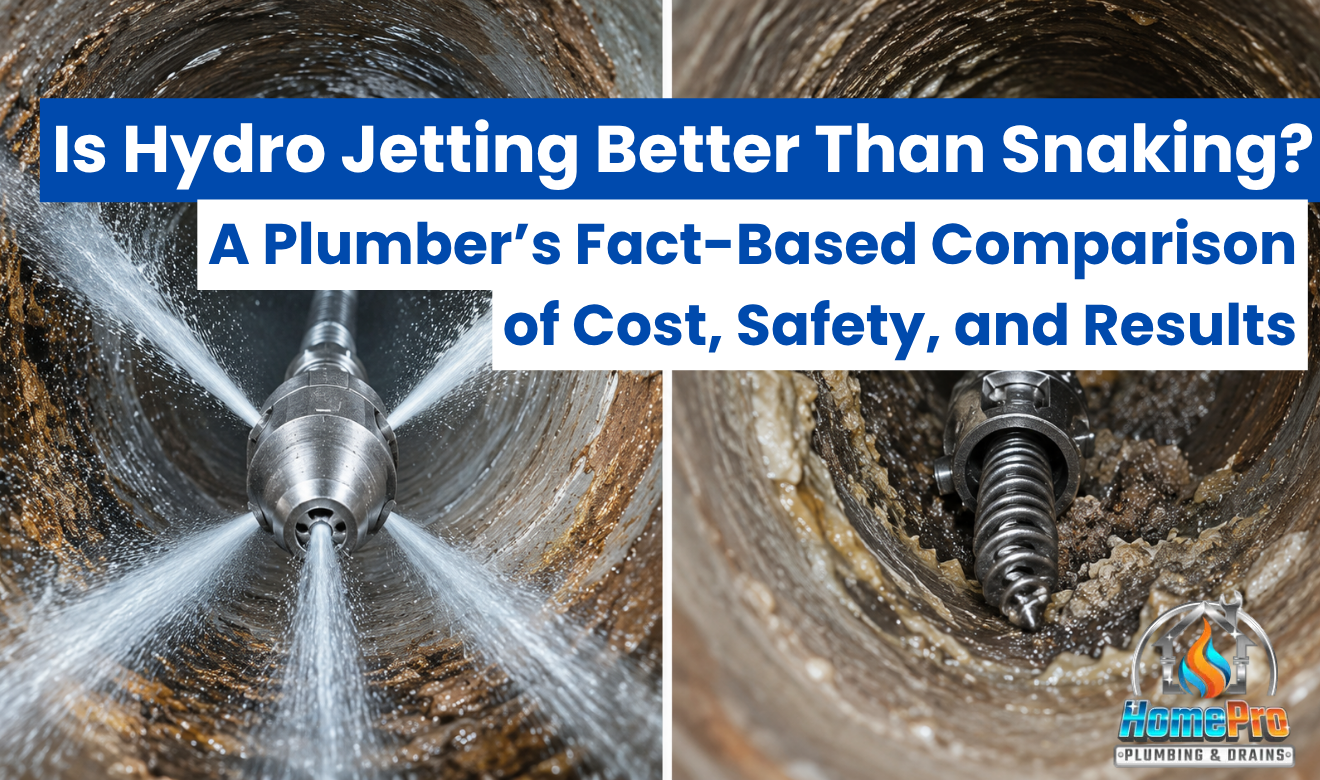
Is Hydro Jetting Better Than Snaking? A Plumber’s Fact-Based Comparison of Cost, Safety, and Results
Executive Summary
Hydro jetting is generally better than snaking for recurring drain clogs because it cleans the full interior circumference of the pipe and removes buildup that a cable often leaves behind. Snaking is usually the better choice for a single, localized obstruction that needs fast removal with minimal setup.
Core Insights
- Match the tool to the clog type: Use a snake for discrete blockages (hair, wipes, small objects) and hydro jetting for pipe-wall deposits (grease, soap scum, sludge, scale) that reduce effective diameter.
- Recurrence is the deciding signal: If a drain re-clogs in days or weeks, it typically indicates buildup or a structural issue where hydro jetting (often after camera confirmation) delivers more durable results than “hole-punch” snaking.
- Pipe condition controls safety and outcome: Camera inspection is the best way to confirm material and defects (roots, offsets, bellies, Orangeburg, failing cast iron) so pressure, nozzle choice, or repair—not just cleaning—solves the root cause.
Is Hydro Jetting Better Than Snaking is true for most recurring drain clogs because hydro jetting scours the full pipe wall while snaking usually only bores a narrow path through the blockage. A drain snake works well for a single obstruction like a wad of wipes lodged in a 2-inch bathroom line or a small hair plug sitting in a P-trap. Hydro jetting works better for buildup problems like grease coating the inside of a 3-inch kitchen branch, soap-and-scale narrowing a cast-iron stack, or roots spreading through an older clay or Orangeburg sewer lateral. A typical snaking call clears flow fast, but it can leave a slick layer behind that catches debris again within weeks. A proper jetting job uses a high-flow nozzle to push debris downstream and peel sludge from the pipe’s circumference, which restores carrying capacity and improves long-term results.
How hydro jetting and snaking actually work inside a drain line
Summary: Snaking uses a rotating cable to penetrate or retrieve a clog, while hydro jetting uses high-pressure water and specialized nozzles to clean the pipe’s interior surface. The methods solve different problems because they interact with blockages in fundamentally different ways.
A drain auger (snake) is a flexible steel cable fed through a cleanout or fixture drain. A cutting head or retrieval tip breaks through an obstruction, often restoring flow quickly. In contrast, hydro jetting relies on a jetter machine that delivers water through a hose to a nozzle designed to propel itself forward and shear buildup off the pipe wall while flushing debris downstream.
- Snaking: Best at “punching through” localized obstructions, pulling out hair, or catching foreign objects.
- Hydro jetting: Best at removing continuous pipe-wall deposits like grease, soap scum, scale, and certain root intrusions after cutting.
For a recurring clog, the key question is whether you’re fighting a single plug or a pipe that has lost its effective diameter due to coating and deposits.
When snaking is the better choice
Summary: Snaking is the first-line tool for simple, localized clogs and for situations where you need fast restoration of drainage with minimal setup. It is also commonly used when access is limited to smaller fixture drains.
Snaking is often the correct choice when the clog is confined to a short section and you can reasonably expect a discrete obstruction.
- Hair and soap plugs in tubs, shower drains, and lavatory lines (often 1-1/2″ to 2″).
- Foreign objects such as wipes, small toys, hygiene products, or excessive paper in toilet branches.
- P-trap and near-trap obstructions where removal and reset is practical.
- Initial emergency flow restoration before a deeper diagnostic step (like camera inspection).
Snaking has a strong “time-to-drain” advantage: the setup is quick, and a skilled technician can clear many fixture clogs in a single visit without placing high volumes of water into a slow system.
When hydro jetting is the better choice
Summary: Hydro jetting is usually superior for repeat stoppages caused by buildup because it cleans the full circumference of the pipe. It is also the preferred cleaning method for many commercial lines that accumulate grease and sludge.
If the underlying issue is narrowing of the line (not a single lodged item), hydro jetting is designed to restore carrying capacity by removing layers that a cable often leaves behind.
- Grease-lined kitchen drains where fats, oils, and grease (FOG) have hardened along the pipe wall.
- Soap + mineral scale in older galvanized or cast-iron systems where internal corrosion and scaling reduce diameter.
- Sewer laterals with chronic sludge from long runs, low slope, or repeated heavy solids loading.
- Root intrusion management after mechanical cutting, to flush fine root hairs and debris (jetting does not “repair” a cracked joint).
Hydro jetting is typically paired with an evaluation step so the technician can choose nozzle type and pressure strategy and avoid forcing water into a compromised pipe.
Decision framework: choose the method based on the failure mode
Summary: The correct method follows the cause: “single obstruction” favors snaking, while “pipe-wall buildup” favors jetting. Recurrence timing and what comes back up are practical indicators.
Use these on-site clues to decide which solution is technically aligned with the clog type:
- Recurrence interval
- Clog returns in days to weeks: typically grease/soap/sludge buildup or partial collapse.
- Clog is rare and isolated: often a one-off obstruction.
- Symptoms across fixtures
- One fixture slow: branch-line issue, often snake-friendly.
- Multiple fixtures backing up: main line or stack—often needs camera + jetting or repair.
- What’s in the backup
- Greasy, dark sludge: favors hydro jetting.
- Hair and fibrous debris: may be solved by snaking, sometimes followed by jetting for a full clean.
If you already know your home has older materials (cast iron, clay tile, Orangeburg), the safest path is to verify pipe condition before aggressive cleaning.
What a professional process looks like (inspection-first, then cleaning)
Summary: The most reliable approach is “diagnose, then clean,” typically using a camera to confirm material, offsets, roots, or damage before selecting snaking or jetting. This reduces repeat calls and avoids harming compromised piping.
A standardized field workflow for recurring clogs typically includes:
- Locate the correct access point (cleanout when available) to avoid pulling traps or stressing fixture connections.
- Confirm system behavior by running water at controlled flow and observing drainage response.
- Inspect the line with a camera when recurrence suggests deposits, roots, belly, or structural defects.
- Select the cleaning method based on what’s visible:
- Discrete obstruction: snake/auger first.
- Coating and reduced diameter: hydro jetting.
- Roots: mechanical cutting first, then jetting to flush.
- Post-clean verification by re-scoping or running fixtures to confirm full restoration of flow and to document remaining issues.
For sewer and main-line concerns, a Sewer Camera Video Inspection is the most direct way to choose the correct tool and avoid guesswork.
Safety, pipe-material limits, and when jetting is not appropriate
Summary: Hydro jetting is powerful and must be matched to pipe condition and material; damaged, collapsed, or severely deteriorated lines can be worsened by high-energy cleaning. A camera-confirmed condition assessment is the control step.
Jetting should be approached conservatively in these situations:
- Known or suspected Orangeburg pipe (bituminous fiber). It is deformation-prone and often fails by collapse; cleaning does not restore structural integrity.
- Severely corroded cast iron with heavy scaling and thin walls. Jetting may dislodge large corrosion sheets and expose weak sections.
- Separated joints, offsets, bellies, or partial collapses where water can accelerate a blockage downstream or worsen a misalignment.
Snaking also has limitations: aggressive cutters can snag, jump joints, or damage fragile piping if the line is compromised. For either method, the controlling factor is pipe condition—not just the clog.
Side-by-side comparison table (what changes your long-term result)
Summary: The best method depends on whether you need “flow restored” or “pipe restored.” The table below consolidates practical performance factors and common local operating norms.
| Feature / Metric | Specifications | Local Guidelines |
|---|---|---|
| Best use case | Snaking: localized obstruction removal. Jetting: pipe-wall cleaning and sludge/grease removal. | For recurring backups, camera-based diagnosis is commonly used before selecting a method to reduce repeat stoppages. |
| Cleaning coverage | Snaking opens a path; hydro jetting scours the interior circumference when properly applied. | Kitchen branches and main sewers with grease/sludge generally benefit from full-bore cleaning rather than “hole-punched” flow. |
| Recurrence risk | Higher after snaking if buildup remains; lower after jetting when deposits are the cause. | If stoppages return quickly, escalation to camera inspection and full cleaning is standard practice. |
| Root intrusion handling | Often requires mechanical cutting first; jetting is effective for flushing fine roots and debris afterward. | Roots indicate a defect at joints or transitions; cleaning manages symptoms, but repair may be required for permanent resolution. |
| Risk factors | Snaking can snag or damage fragile lines with aggressive heads; jetting can worsen failures in deteriorated or collapsed pipe. | Verification of pipe material/condition is the controlling safety step before high-energy cleaning. |
Cost and value: what you are really paying for
Summary: Snaking is typically less expensive upfront because it is faster and uses simpler equipment, while hydro jetting costs more because it is a deeper cleaning procedure. Long-term value depends on whether it prevents repeat stoppages and secondary damage.
Cost varies by access, line length, severity, and whether inspection is included, but value is best assessed with these measurable outcomes:
- Number of repeat clogs prevented over the next several months.
- Restored pipe diameter (a camera can verify how clean the wall is).
- Reduced risk of overflows that can damage cabinets, flooring, or drywall.
If you want a realistic budgeting approach before scheduling work, review plumbing service cost estimates to see how plumbers typically structure pricing for diagnostics versus corrective work.
How to prevent the next clog after jetting or snaking
Summary: Cleaning resets the line, but prevention requires changing what enters the drain and maintaining water flow characteristics. A few enforceable household rules outperform most “drain chemicals” in real-world outcomes.
Use these controls to keep the pipe clear:
- Kitchen:
- Never pour grease into a sink; collect and dispose of it in a sealed container.
- Run hot water only as a rinse aid, not as a “grease remover” (it cools downstream and re-solidifies).
- Use strainers to keep rice, pasta, coffee grounds, and fibrous peels out of the drain.
- Bathroom:
- Install hair catchers and clean them weekly.
- Do not flush wipes (including “flushable” labeled products), paper towels, or hygiene products.
- Whole-home habits:
- Address slow drains early before full blockage forces wastewater into fixtures.
- Avoid repeated caustic or acid drain cleaners that can damage piping and create hazardous conditions for technicians.
For a broader understanding of how drainage ties into the overall plumbing system and maintenance responsibilities, it helps to know the fundamentals of plumbing and how drainage, venting, and water supply interact.
Signs you need more than cleaning (repair or replacement triggers)
Summary: Some recurring clogs are symptoms of structural failure, not dirt. If the camera shows deformation or damage, cleaning will be temporary and can delay the correct fix.
Escalate from cleaning to repair planning if you see any of the following indicators:
- Backups in multiple fixtures with gurgling and sewer odor, especially after heavy use.
- Camera-confirmed belly (a low spot holding water) where solids settle repeatedly.
- Offset joints or separated pipe sections that catch paper and solids even after cleaning.
- Recurring root intrusion that returns quickly, indicating a persistent entry point.
- Deteriorated pipe material that is flaking, collapsing, or heavily deformed.
In these cases, cleaning is still useful for stabilization, but the durable solution is a targeted repair or a trenchless rehabilitation strategy depending on condition and access.
Bottom line: the “better” option is the one that matches the clog’s cause
Summary: Hydro jetting is generally better for recurring clogs caused by buildup because it cleans the entire pipe wall, while snaking is better for isolated obstructions that need quick removal. The most defensible choice is made after confirming pipe condition and blockage type.
Use this decision rule to keep results consistent:
- Choose snaking when the stoppage is a single, localized obstruction (hair, wipes, a near-trap plug) and the line is otherwise in serviceable condition.
- Choose hydro jetting when the line repeatedly slows due to grease, sludge, soap scum, mineral scale, or post-root debris that reduces diameter along a longer run.
- Add a camera inspection when stoppages recur, multiple fixtures are affected, or the building has older piping where cleaning strategy must be matched to material and condition.
That’s how you get beyond “temporary flow” and into a verified, long-term drain solution.
Frequently Asked Questions
Stop Guessing at Your Drain Clog—Fix the Cause Before It Turns Into a Messy, Expensive Emergency
A “quick snake” can feel like a win… right up until the drain backs up again, wastewater spills where it shouldn’t, and you’re suddenly dealing with flooring damage, cabinet swelling, mold risk, or a main-line overflow that shuts down your whole home. And if the real problem is grease buildup, scale, root intrusion, or an aging line that’s partially collapsed, DIY tools and off-the-shelf chemicals don’t solve it—they often hide the symptoms long enough to make the next failure worse.
Here’s what can go wrong when this isn’t handled by an experienced local pro:
- You clear a small hole, not the pipe: Snaking may restore flow but leave the slick coating behind—so debris grabs on and the clog comes right back.
- You push the problem downstream: A partial blockage can turn into a full stoppage deeper in the line—exactly where it’s harder and more expensive to reach.
- You damage fragile piping: Aggressive cutting heads can snag or jump joints, and high-pressure water in the wrong situation can worsen already-compromised pipe.
- You miss the real cause: Roots, bellies, offsets, or deteriorated materials (like older clay, cast iron, or Orangeburg) require the right strategy—usually verified by camera before heavy cleaning.
If your drain keeps slowing down, backing up, or affecting multiple fixtures, the smart move is to stop treating it like a “clog” and start treating it like a system problem. Get a technician who can diagnose what’s happening inside the line, choose the right method (snake vs. hydro jetting), and confirm the result—so you’re not paying for the same problem twice.
Related Posts

Plumbing Code Compliance Services in San Diego, CA: Requirements, Permits, and Inspection Checklist
Key Takeaways In San Diego, “code-compliant plumbing” generally means meeting the California Plumbing Code as…

How to Choose a Licensed Plumbing Contractor in San Diego, CA
Key Takeaways Choosing a Licensed Plumbing Contractor San Diego homeowners can rely on comes down…