Key Takeaways
Water pressure regulator replacement San Diego homeowners need is most often the right fix when whole-house pressure is consistently high, low, or fluctuating and won’t stabilize with safe adjustment. The most reliable next step is verifying static and flowing pressure with a gauge and confirming the regulator is the failure point before replacing it on the main line.
- Whole-house symptoms point to the PRV: When multiple fixtures share the same pressure problem—such as spikes, surging, or a hose bib gauge reading that stays abnormal even after adjustment attempts—the regulator becomes a prime suspect.
- Not all “bad pressure” is regulator failure: Localized issues (one bathroom, one hose bib, or hot-side only) often indicate partially closed valves, clogged aerators, fixture/cartridge problems, old galvanized restrictions, or hidden leaks rather than a PRV that needs replacement.
- Replacement hinges on access and verification: Because the regulator sits on the main line, a typical appointment involves shutting off and depressurizing the system, installing a correctly oriented and sized valve, then setting and rechecking pressure under different demand conditions, with cost driven by access, pipe material, and fitting condition.
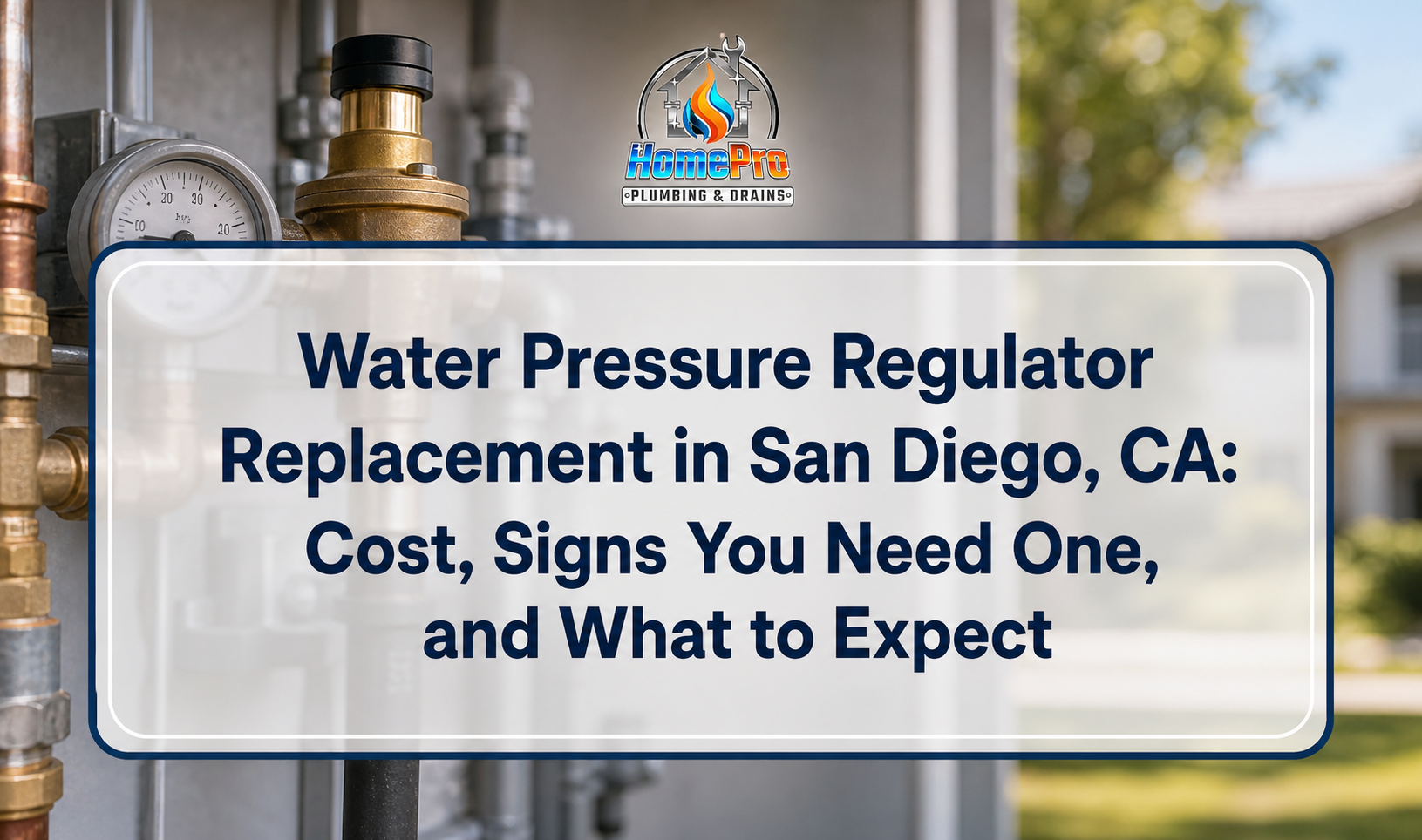
Water pressure regulator replacement San Diego homeowners need is typically recommended when a failing regulator causes consistently high, low, or fluctuating water pressure throughout the house. A properly working regulator helps keep pressure at a steady level to protect plumbing fixtures, water heaters, and appliances from wear caused by pressure spikes.
In San Diego, a pressure regulator is usually installed on the main water line where it enters the home, often near the shutoff valve. Common signs of trouble include banging pipes (water hammer), dripping fixtures that won’t stop, sudden changes in shower pressure, or a pressure gauge reading that’s above a typical residential range. Because the regulator is tied into the main supply, replacement generally involves shutting off water, depressurizing the system, and confirming settings after installation.
This guide covers typical replacement costs, how to recognize regulator failure versus other causes, and what to expect during an on-site evaluation and installation so you can plan the repair with fewer surprises.
How a Water Pressure Regulator Works (and Why It Matters in San Diego)
A water pressure regulator—often called a pressure reducing valve (PRV)—keeps incoming city water pressure at a steady, safer level for your home’s plumbing system. When it fails, the entire house can experience damaging pressure swings that accelerate leaks and wear.
Municipal supply pressure can vary by neighborhood, time of day, and elevation. A regulator helps “smooth out” that variability so fixtures and appliances receive consistent pressure rather than spikes that stress hose bibbs, angle stops, toilet fill valves, and washing machine supply lines.
Most residential regulators use a spring-and-diaphragm design. Turning the adjustment screw increases or decreases the set pressure, but internal components can wear over time or become fouled by debris.
- Too-high pressure can contribute to dripping faucets, running toilets, and premature failure of water heaters and appliance valves.
- Too-low pressure can make showers weak, irrigation underperform, and multiple fixtures unusable at the same time.
- Fluctuating pressure often points to a regulator that can’t hold a stable set point under changing demand.
Common Signs You May Need Water Pressure Regulator Replacement in San Diego
Most homeowners first notice symptoms at fixtures, but the root cause may be at the main line where the regulator is installed. The key clue is that the problem affects multiple fixtures across the home rather than one isolated location.
Some symptoms overlap with other plumbing problems, so it’s helpful to note when the issue happens (only during high demand, only hot side, random spikes, etc.).
- Consistently high pressure (often revealed by a hose bib gauge) that won’t come down after adjustment attempts.
- Sudden pressure spikes that make pipes bang or cause shower temperature/pressure to surge.
- Pressure drops when a second fixture turns on beyond what’s typical for your home.
- Weeping or leaks around the regulator body or at nearby fittings.
- Recurring fixture failures (toilet fill valves, faucet cartridges) that seem unusually frequent.
If you’re also seeing unexplained drops in pressure, it can help to compare regulator symptoms with other causes described in what causes sudden loss of water pressure in a house.
Regulator Failure vs. Other Causes of Bad Water Pressure
Not every pressure issue is a regulator problem; clogs, leaks, partially closed valves, and failing fixtures can mimic PRV failure. A good evaluation separates “whole-house” issues from “branch line” or “single fixture” restrictions.
When It’s Likely the Regulator
If multiple fixtures show the same pressure problem and your inlet pressure is higher than your set pressure, the regulator becomes a prime suspect. A regulator that’s worn internally may creep upward or fluctuate.
- Pressure reads high even after adjustment
- Pressure increases over time when no water is running (pressure “creep”)
- Noticeable house-wide surging when water demand changes
When It Might Be Something Else
If the issue is isolated to one bathroom, one hose bib, or only the hot side, you may be looking at a localized restriction or equipment issue. These problems often persist even if the regulator is replaced.
- Partially closed main valve or water meter valve restricting flow
- Clogged aerators/showerheads or debris in angle stops
- Old galvanized piping or severe internal corrosion restricting volume
- Hot-side only pressure issues tied to water heater shutoff, heat traps, or sediment
- Hidden leaks that drop pressure under demand and raise water bills
When a pressure problem is tied to a suspected leak (especially under slabs or behind walls), a targeted evaluation may be needed before replacing parts. In those situations, how plumbers detect hidden leaks can clarify what diagnostic tools and steps are typically used.
Quick Reference: Pressure, Symptoms, and What to Check First
This table helps you connect what you’re seeing at fixtures to practical next checks before committing to a replacement. It’s not a substitute for an on-site diagnosis, but it can reduce guesswork.
| Symptom / Observation | What It Often Indicates | What to Check Next (San Diego Homes) |
|---|---|---|
| House-wide pressure reads unusually high at a hose bib gauge | Regulator not reducing pressure, misadjusted PRV, or failed internals | Confirm gauge accuracy; verify PRV adjustment changes pressure; inspect PRV for leaks/corrosion |
| Pressure rises when no water is running (“creep”) | PRV seat not sealing; thermal expansion can also contribute | Watch gauge for 10–30 minutes; check for expansion tank presence/condition if applicable |
| Weak flow at one faucet or shower only | Local blockage, cartridge issue, angle stop restriction | Clean aerator/showerhead; inspect stops; test other fixtures to confirm it’s localized |
| Pressure drops sharply when multiple fixtures run | Undersized piping, partially closed valve, failing PRV under flow, or supply restrictions | Check main valve position; evaluate PRV performance under load; consider piping age/material if older home |
| Banging pipes (water hammer) with quick-closing valves | High pressure and/or missing/failed hammer arrestors; loose piping | Measure pressure; inspect washing machine/dishwasher connections; assess need for arrestors and secure piping |
What Happens During an On-Site Evaluation and Replacement
A professional replacement typically includes confirming actual pressure readings, inspecting the installation area, and verifying stable performance after the new regulator is installed. Because it’s on the main line, the process is more involved than a typical fixture repair.
Access and pipe material matter. Some homes have regulators in tight exterior boxes; others have them in garages or at the side yard near the main shutoff, sometimes with older fittings that require extra care.
Typical Evaluation Steps
The goal is to confirm the regulator is the failure point and identify related issues that could affect performance. This helps avoid replacing a PRV when the real problem is a valve restriction, debris, or a leak.
- Check static and flowing pressure with a gauge (often at a hose bib).
- Inspect main shutoff, meter area (as accessible), and regulator condition.
- Test regulator adjustment response (if it’s adjustable and safe to test).
- Look for signs of thermal expansion or cross-connection symptoms (as applicable).
- Confirm whether downstream fixtures show consistent symptoms across the home.
Typical Replacement Steps
Replacement generally requires shutting off water, depressurizing the plumbing, removing the old valve, and installing a properly sized regulator with correct orientation. After installation, pressure is set and verified under different flow conditions.
- Shut off water at the main and relieve pressure by opening a faucet.
- Remove the old regulator and prepare pipe ends/fittings.
- Install the new regulator (and unions/fittings as needed) with correct flow direction.
- Slowly restore water, check for leaks, and flush air/debris from the line.
- Adjust the set pressure and recheck at multiple fixtures.
Depending on your setup, a plumber may recommend additional components (for example, serviceable unions for easier future replacement). Any add-ons should be explained clearly because not every home needs the same configuration.
Typical Cost Drivers for Water Pressure Regulator Replacement in San Diego
Pricing varies mainly based on access, pipe material, and whether additional repairs are required to safely install the new regulator. The most accurate estimate comes after a plumber sees the existing installation.
Because it’s easy to find ranges online that don’t match your home, focus on the variables that legitimately change labor time and parts rather than a single “average” number.
- Location and accessibility (tight meter box vs. open wall/garage install)
- Pipe material and connection method (copper, galvanized, PEX transitions, etc.)
- Condition of existing fittings (corrosion or seized threads can increase labor)
- Need for a shutoff upgrade if the existing main valve doesn’t fully close
- Related issues discovered during testing such as leaks, debris, or inconsistent municipal pressure
If you want a clearer sense of how estimates are typically structured (service call, labor, parts, and contingencies), see plumbing service cost estimates in San Diego.
Choosing the Right Replacement Regulator (Without Overbuying)
The “best” regulator is the one that matches your home’s pipe sizing, expected flow, and install constraints while remaining serviceable. A quality valve installed incorrectly—or sized poorly—can still produce unstable pressure.
Most homeowners don’t need to pick the model themselves, but understanding the decision points helps you review recommendations confidently.
- Correct sizing to match the main line and household demand (sizing affects pressure stability under flow).
- Serviceability (some valves allow easier maintenance or rebuilds than others).
- Material quality for longevity in outdoor exposures common in San Diego side-yard installs.
- Compatibility with your piping system and existing fittings to minimize unnecessary rework.
A regulator’s job is to control pressure—not fix flow restrictions caused by old piping or heavy mineral buildup. If pressure is “fine” at the regulator but weak at fixtures, it may be time to investigate distribution piping or localized restrictions instead of replacing the PRV again.
DIY Checks Homeowners Can Do Before Scheduling Replacement
A few simple checks can help you describe the problem accurately and avoid unnecessary work. These steps are generally safe for homeowners, but do not attempt to disassemble the regulator or cut into the main line without proper tools and experience.
- Take a pressure reading at a hose bib with a screw-on gauge (static pressure when no water is running).
- Test pressure under flow by opening a faucet and observing whether pressure drops dramatically.
- Check multiple fixtures across hot and cold to see if the issue is whole-house or localized.
- Listen for hammering when appliances shut off (washing machine, dishwasher), which can correlate with high pressure.
- Look for visible seepage around the regulator and nearby fittings.
If you find signs of leaks, address those quickly—pressure issues can be both a cause and a symptom of leaks in the system. For broader plumbing concerns, it may make sense to schedule general plumbing service so the technician can evaluate the regulator in context with valves, fixtures, and any leak indicators.
Risks of Delaying a Failing Regulator
Putting off a failing PRV can expose your home to repeated pressure spikes or prolonged high pressure, which increases the chance of fixture leaks and nuisance failures. The risk isn’t identical for every home, but it rises when pressure is consistently high or unstable.
- Hidden leaks become more likely as higher pressure stresses weak points at fittings and supply lines.
- Appliance wear accelerates (fill valves, solenoids, icemakers, washing machine hoses).
- Water hammer can worsen and may contribute to loosened pipe supports and noisy operation.
- Water heater stress can increase when pressure spikes combine with temperature-related expansion.
Plumbing systems are interconnected; pressure-related issues can show up as drips, leaks, and component failures throughout the house. If you’d like more background on how plumbing systems are generally arranged and why main-line components matter, you can review plumbing for a high-level overview.
Planning Your Repair: How to Get a Clear Scope (and Fewer Surprises)
The best outcomes come from confirming the cause, replacing only what’s necessary, and verifying performance after the install. A good plan also includes setting expectations for water shutoff time and access needs.
When scheduling water pressure regulator replacement San Diego homeowners should be prepared to share a few details that speed up diagnosis and quoting.
- Share your gauge readings (static and under flow) if you have them.
- Describe where the regulator is located (side yard, garage, meter box) and whether access is clear.
- Note timing patterns (only mornings, only when irrigation runs, random spikes, etc.).
- Mention any recent plumbing work or changes in pressure you noticed after repairs.
- Ask how pressure will be verified after installation (set point and stability under load).
A thoughtful evaluation can also identify related items worth addressing at the same time—like a main shutoff that doesn’t fully close, or obvious signs of corrosion at the regulator connections. If you want to know how a typical appointment is structured from arrival to testing to recommendations, what to expect during a plumbing service call is a helpful walkthrough.
Get Back to Stable, Safe Water Pressure—Without Guesswork
Stable water pressure protects fixtures, reduces nuisance leaks, and makes daily use more comfortable across showers, sinks, and appliances. The right next step is confirming whether the PRV is truly failing or whether another restriction or leak is driving the symptoms.
By checking pressure with a simple gauge, noting whether the issue is whole-house or localized, and understanding what an on-site replacement involves, you can make a more confident decision when scheduling water pressure regulator replacement in San Diego.
Frequently Asked Questions
Schedule a Water Pressure Regulator Check for Reliable Whole-Home Pressure
If your water pressure is running high, low, or constantly changing, a quick evaluation can confirm whether the pressure regulator is actually failing or if another restriction, valve issue, or leak is causing the symptoms. Getting the right diagnosis helps protect fixtures and appliances from ongoing wear while restoring consistent performance at showers, sinks, and irrigation.
Because the regulator sits on the main line, replacement often involves shutoff coordination, correct sizing, solid connections, and careful post-install pressure testing. A professional assessment can also catch related concerns—like a main shutoff that won’t fully close or fittings showing corrosion—before they create bigger headaches.