



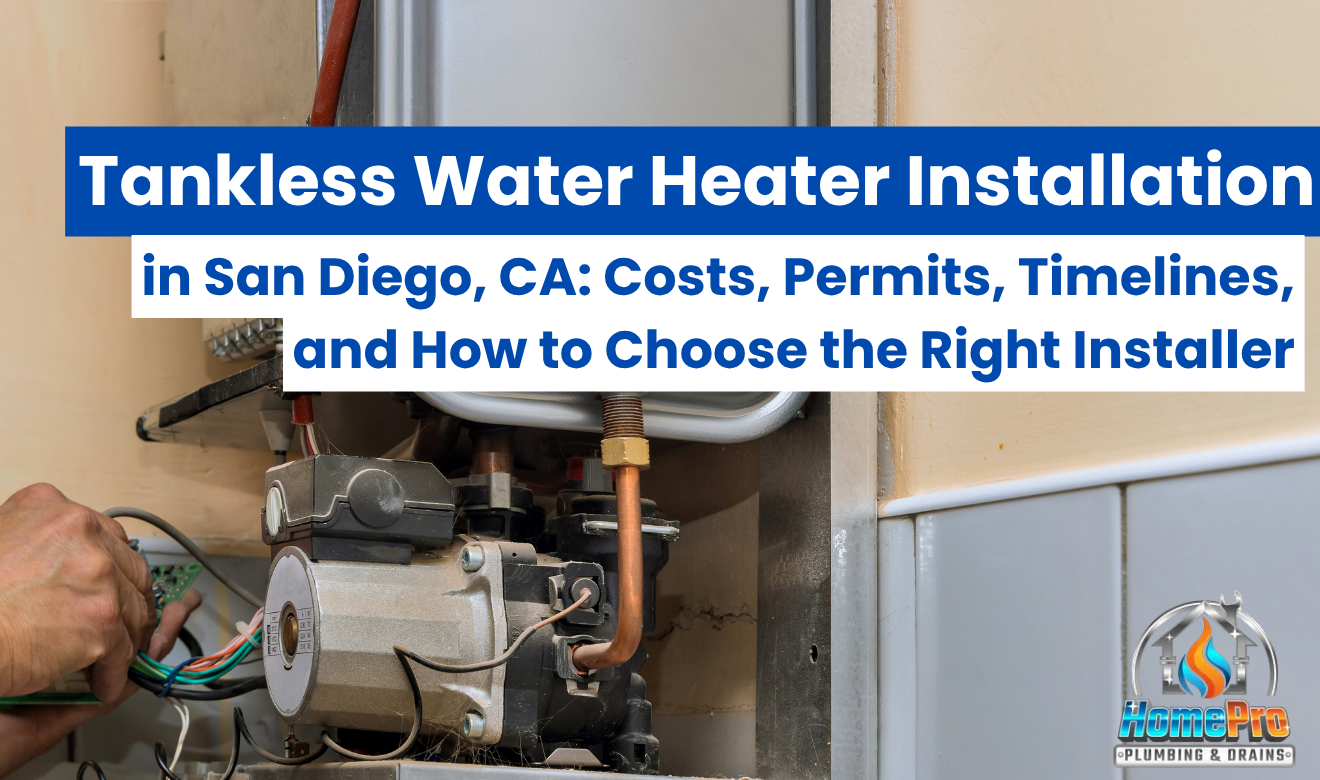
Tankless Water Heater Installation in San Diego, CA: Costs, Permits, Timelines, and How to Choose the Right Installer
Executive Summary
Tankless water heater installation San Diego is a code-driven project that succeeds only when the unit is sized for real simultaneous demand and the home’s gas/electrical capacity, venting, and condensate routing are verified before installation. The definitive path to stable hot water and a clean inspection is capacity validation first, code- and manufacturer-compliant installation second, and startup testing under load last.
Core Insights
- Sizing Must Match Real Use: Correct equipment selection depends on total simultaneous GPM and required temperature rise based on measured/verified fixture demand and local incoming water conditions.
- Utility Capacity Drives Scope: Gas units commonly require meter and pipe sizing verification (BTU load, developed length, inlet pressure), while electric units often require panel/service confirmation, dedicated breakers, and properly sized conductors.
- San Diego Compliance Is Venting + Condensate + Permit Inspection: Condensing models require approved corrosion-resistant venting with correct slope/clearances and a manufacturer-compliant condensate route (often with neutralization), and most installs must pass permit inspection for seismic and safety items.
Tankless water heater installation San Diego is the process of replacing or adding an on-demand gas or electric water heater in a San Diego property, including code-compliant venting, gas or electrical upgrades, condensate handling, and permit inspection. In San Diego, typical install scope starts with verifying fuel type, BTU load, and fixture demand, such as running a shower, dishwasher, and clothes washer at the same time in a Mira Mesa or Clairemont single-family home. Gas units often require checking the existing gas line size, total developed length, and meter capacity, because undersized piping can cause ignition failure or lukewarm water during peak flow. Condensing models usually need a condensate drain route and a neutralizer, plus corrosion-resistant vent materials and correct termination clearances from windows and eaves to meet California Mechanical Code requirements. Electric units can require a panel capacity review, added breakers, and larger service, which is common in older San Diego homes with limited amp capacity. Permits are frequently required for water heater replacement in San Diego County jurisdictions, and inspections typically verify seismic strapping, T&P discharge piping to an approved termination, proper gas shutoff and sediment trap where applicable, and correct vent slope and support. Timelines vary by complexity, with a straightforward swap near the same location often completed in a day, while jobs involving a gas line upsizing, new vent route through a roof or sidewall, or electrical service changes can extend to multiple days and coordinate with inspection scheduling.
What Makes an On-Demand Water Heater Install Different in San Diego
San Diego installs are defined by strict combustion-air and venting rules, variable incoming water temperatures, and frequent gas or electrical capacity limitations in older housing stock. A successful job starts with sizing for real fixture demand and ends with a permit inspection that confirms safety and code compliance.
Unlike a basic tank swap, an on-demand upgrade often requires multiple trade considerations at once:
- Fuel supply verification (gas line diameter, developed length, meter/utility capacity, or electrical panel/service capacity)
- Venting and combustion air planning under California Mechanical Code (CMC) requirements for Category IV appliances (typical for condensing units)
- Condensate management for condensing models (routing, protection, and neutralization where required by manufacturer instructions)
- Water pressure and flow assessment so the heater can maintain setpoint temperature during simultaneous use
- Seismic and safety provisions that inspectors verify during final sign-off
Correct Sizing: Flow Rate, Temperature Rise, and Simultaneous Use
Proper sizing is the difference between “endless hot water” and temperature drop during peak use. In San Diego, sizing must account for incoming water temperature, desired outlet temperature, and how many fixtures may operate at the same time.
A sizing review typically follows a measurable approach:
- List fixtures likely to run simultaneously (e.g., shower + dishwasher + clothes washer).
- Estimate total GPM demand using fixture specifications (or measured bucket test at a faucet/shower).
- Calculate temperature rise (desired outlet temperature minus incoming cold-water temperature).
- Select equipment whose published performance curve supports that GPM at the required temperature rise.
Local reality: even within San Diego County, incoming water temperatures and static pressure can vary with neighborhood elevation and supply zone. That is why field verification (not guesswork) matters before picking unit capacity.
Gas Tankless Install Requirements: Meter Capacity, Pipe Sizing, and Combustion Safety
Gas models often trigger the most “hidden” scope because the burner input is high and the appliance is sensitive to pressure drop. If gas piping and the meter are not sized correctly, the unit can fail to ignite, short-cycle, or deliver fluctuating outlet temperatures.
Key items a plumber evaluates before installing a high-BTU appliance:
- Appliance input (BTU/hr) from the manufacturer rating plate
- Total connected load on the gas system (furnace, cooktop, dryer, pool heater, etc.)
- Gas meter rating and available capacity for the added or upgraded load
- Existing pipe size and material and whether it’s approved for the fuel type
- Developed length (actual run length including fittings equivalent length) to the appliance
- Required sediment trap and an accessible manual shutoff valve at the appliance (as applicable by code and manufacturer installation instructions)
Because gas piping design is governed by adopted mechanical/plumbing standards (including sizing tables and pressure requirements), installers typically use the applicable code method and the manufacturer’s specified inlet pressure range. When a home’s main gas trunk is undersized, the compliant fix is usually an upsized branch or a reworked manifold—not “tuning” the heater to compensate.
Electric Tankless Install Requirements: Panel Capacity, Breakers, and Conductor Sizing
Electric on-demand units can require very high amperage, and in many older San Diego homes the electrical service is the limiting factor. A code-compliant installation depends on verifying service capacity, correct breaker sizing, and correctly sized conductors per the heater’s nameplate and installation manual.
Electrical scope commonly includes:
- Main panel load review to confirm the service can support additional continuous load
- Dedicated circuits as specified by the manufacturer (many units require multiple double-pole breakers)
- Correct conductor sizing and termination rated for the breaker and unit lugs
- Bonding/grounding verification consistent with the electrical code and manufacturer requirements
If the panel or service is undersized, the compliant pathway is an electrical upgrade performed to current standards and inspected by the Authority Having Jurisdiction (AHJ). Attempting to “make it work” without the required service capacity can create nuisance trips, overheating conductors, and failed inspections.
Venting and Clearances: What Inspectors Look For in San Diego
Venting is not optional engineering—it is a safety system that must match appliance category, materials, slope, and termination rules. In San Diego jurisdictions, installations are commonly checked against the California Mechanical Code and the manufacturer’s installation instructions, with the stricter rule governing.
For modern condensing gas units (often Category IV), typical requirements include:
- Approved vent material (as listed by the manufacturer; many require corrosion-resistant systems due to acidic condensate)
- Correct vent routing with required slope and support to manage condensate and prevent sagging
- Termination clearances from openings such as windows/doors and from eaves/rooflines, per code and manufacturer instructions
- Intake/exhaust separation for direct-vent configurations to prevent recirculation of flue gases
Condensing appliances also require planning for where condensate will go (see next section). This is one of the most common reasons “simple” swaps become more involved when moving from a tank-style atmospheric vent to a sealed combustion condensing unit.
Condensate Handling for Condensing Tankless Models
Condensate from high-efficiency units is acidic and must be managed exactly as the manufacturer specifies. A compliant install routes condensate to an approved drain point and often incorporates treatment, depending on the installation instructions and local requirements.
A standard condensate scope may include:
- Condensate drain line routing to an approved receptor or drain connection
- Neutralizer installation when required by the manufacturer or specified as part of the installation method
- Freeze and blockage prevention for exterior runs (San Diego is mild, but routing still must avoid traps and low points that hold debris)
- Air gap or approved indirect connection where required by plumbing code for drain protection
Permits and Inspection in San Diego County Jurisdictions
Most San Diego-area water heater replacements require a permit, and the final inspection is where safety items are verified in the field. Inspections commonly focus on seismic, gas shutoff/sediment trap (where applicable), venting, and temperature/pressure relief discharge requirements.
While permit rules vary by city and unincorporated county area, inspections frequently verify:
- Seismic strapping and anchorage method appropriate for the installation location
- T&P discharge piping routed to an approved termination point (where a storage tank exists, or where required by the configuration)
- Gas shutoff valve accessibility and proper connection method
- Sediment trap configuration where required for gas appliances
- Venting material, slope, support, and termination clearances
- Water shutoff and serviceability clearances for maintenance
Because AHJs enforce adopted codes and installation instructions, a best practice is to keep appliance documentation on-site during install day so the venting and condensate details can be matched exactly.
Installation Workflow: From Pre-Check to Startup Testing
A professional installation follows a defined sequence that reduces call-backs and inspection failures. The goal is to confirm capacity first, install to code second, and verify performance last.
Typical step-by-step workflow:
- Site assessment: location, access, fuel type, vent route feasibility, drain proximity, and water pressure.
- Demand and sizing confirmation: fixture count, expected simultaneous use, and temperature rise.
- Utility capacity verification: gas meter and line sizing or electrical panel/service review.
- Demolition and prep: remove old unit (if replacing), verify shutoffs, and protect finishes.
- Core installation: mounting, water piping connections, isolation valves, and filtration/flush provisions as recommended by manufacturer.
- Venting/condensate build-out: approved materials, supports, slope, and drain routing.
- Startup: purge air, leak test, confirm combustion/operation parameters per manufacturer procedures.
- Performance verification: confirm stable outlet temp under load at multiple fixtures.
- Inspection coordination: schedule and ensure access to unit, vent terminations, and shutoffs.
If you want to understand the typical on-site process and how technicians document findings, review what happens during a plumbing service call so the inspection-focused details don’t come as a surprise.
Core San Diego Installation Metrics (Code-Driven Checks)
The table below consolidates the most inspected technical checkpoints into a single quick-reference view. These items are routinely tied to adopted California codes and manufacturer installation instructions, and they map directly to common inspection outcomes.
| Feature / Metric | Specifications | Local Guidelines |
|---|---|---|
| Heater sizing basis | Total simultaneous GPM + required temperature rise based on fixture demand and incoming water temp | Verify performance using manufacturer flow charts; confirm during multi-fixture test before sign-off |
| Gas supply validation | Meter capacity + pipe diameter + developed length must support total connected BTU load | Sizing must follow adopted code tables/methods and manufacturer inlet pressure requirements; undersized piping is a common inspection/callback issue |
| Venting system (condensing) | Approved corrosion-resistant venting, correct slope/support, and compliant terminations | CMC + manufacturer instructions apply; termination clearances from openings/eaves are routinely verified during inspection |
| Condensate management | Drain routing to approved receptor; neutralizer where required; blockage-resistant routing | Follow manufacturer instructions; protect building materials from acidic discharge and confirm acceptable discharge method with AHJ when needed |
| Electrical requirements (electric units) | Dedicated circuits, correctly sized breakers and conductors, proper grounding/bonding | Panel/service must have verified capacity; upgrades require permits and inspection under the electrical code |
| Inspection safety items | Accessible shutoffs, secure mounting, and safe discharge/termination components | Permitted work typically inspected for seismic/safety provisions and code-compliant installation details |
Common Failure Points (and How to Prevent Them)
Most performance complaints trace back to supply capacity, venting errors, or scale buildup—not the heater itself. Preventing issues is primarily a matter of correct design, approved materials, and startup verification.
Most frequent avoidable problems:
- Lukewarm water during peak use: unit undersized for simultaneous GPM or gas pressure drop from undersized piping.
- Ignition or flame errors: insufficient inlet pressure, incorrect gas line sizing, or vent/intake recirculation issues.
- Short cycling at low flow: fixtures below the unit’s minimum activation flow rate or mixing valves bleeding cold.
- Premature scale buildup: hard water conditions without routine flushing per manufacturer guidelines.
- Condensate leaks: improper slope, loose connections, or routing that causes backup.
Because plumbing is a whole-home system, reviewing the broader system design can help homeowners understand why one change affects other fixtures. A useful reference point is the overview of plumbing fundamentals, especially how water distribution and drainage work together.
Maintenance Planning After Installation: Protecting Efficiency and Warranty
Post-install maintenance is a required operational step for most manufacturers, not an optional add-on. A basic plan focuses on descaling frequency, inlet filtration checks, and periodic inspection of venting and condensate components.
Minimum maintenance actions to plan for:
- Annual or periodic descaling/flush according to manufacturer instructions and local water conditions
- Clean inlet water filter (many units include a serviceable screen filter)
- Inspect vent terminations for obstructions and verify supports remain secure
- Inspect condensate drain/neutralizer and replace neutralizer media as required
If you want the installation and long-term support handled under one scope, consider scheduling water heater repair and installation services so the system is maintained to the same standards it was installed under.
A San Diego-Ready Install Checklist That Holds Up Under Inspection
A reliable on-demand system is built on verified utility capacity, code-compliant venting, and documented startup testing. When those elements are handled correctly, the installation typically passes inspection smoothly and delivers stable hot water under real household demand.
Use this final checklist to validate the scope before work begins:
- Load and demand confirmed: fixture count, simultaneous use, and temperature rise calculated using manufacturer performance data.
- Fuel delivery verified: gas meter and piping sized to total BTU load, or electrical panel/service verified for required amperage.
- Venting engineered: approved materials, proper slope/support, and compliant termination clearances under CMC and manufacturer instructions.
- Condensate handled: approved drain point, correct routing, and neutralization where required.
- Safety and serviceability built in: accessible shutoffs, secure mounting, and installation clearances for maintenance.
- Permit/inspection planned: permit pulled when required and inspection scheduled with access to the unit and vent terminations.
When each of these items is addressed up front, tankless water heater installation in San Diego becomes a predictable, code-driven project rather than a series of change orders—resulting in consistent temperature, safe operation, and fewer call-backs.
Frequently Asked Questions
Don’t Gamble With Gas, Venting, or Permits—Get a San Diego Tankless Install Done Right
Tankless water heaters aren’t “swap-and-go” in San Diego. One missed detail—undersized gas piping, a vent termination too close to an opening, an improper condensate route, or an electrical service that can’t support the load—can turn your upgrade into ignition failures, fluctuating hot water, nuisance breaker trips, water damage, or a failed inspection that forces expensive rework.
And here’s the part most homeowners don’t see until it’s too late: an on-demand unit is sensitive. If the gas meter can’t feed total connected BTUs, the heater may run fine at one faucet and fall apart when the shower, dishwasher, and laundry overlap. If the venting material or slope isn’t exactly right, you can end up with corrosive condensate issues or unsafe exhaust conditions. If permits aren’t pulled when required, you risk delays during a sale, insurance headaches, and being forced to “open up” finished work so an inspector can verify it.
HomePro Plumbing and Drains installs tankless systems the way San Diego inspectors expect to see them: correctly sized for your real fixture demand, verified for gas or electrical capacity, built with approved venting and clearances, set up with proper condensate handling, and tested under load so you’re not chasing lukewarm water later.
If you want stable hot water, a clean inspection, and an installation that won’t come back to bite you, get a local pro who does this every day.
Related Posts
Plumbing Code Compliance Services in San Diego, CA: Requirements, Permits, and Inspection Checklist
Key Takeaways In San Diego, “code-compliant plumbing” generally means meeting the California Plumbing Code as…

How to Choose a Licensed Plumbing Contractor in San Diego, CA
Key Takeaways Choosing a Licensed Plumbing Contractor San Diego homeowners can rely on comes down…